


 English
 Español

Types of faucets: Applications, Selection Criteria, and Practical Guidance
Date:2026-11-09
Content
- 1 Three ways to sort the types of faucets that actually matter
- 2 Valve types: the part that decides how a tap behaves
- 3 Mounting types: deck, wall, single hole, widespread and the rest
- 4 Kitchen and bathroom types differ in height, reach and what they must survive
- 5 Handle, spout and spray types change daily use more than the valve does
- 6 Body material and finish types: ABS, stainless steel, brass
- 7 The type most guides forget: where the hot water actually comes from
- 8 How one instant electric range spreads across faucet types
- 9 Safety and electrical checks that only apply to heated taps
- 10 Matching the type to water conditions and the people using it
- 11 Specifying for a project: what distributors, contractors and OEM buyers should check
- 12 Common specification mistakes worth avoiding
- 13 Where to look next
- 14 FAQ: types of faucets
- 14.1 How many types of faucets are there?
- 14.2 Which valve type lasts the longest?
- 14.3 Is an instant electric faucet a faucet or a water heater?
- 14.4 What power supply does an instant electric faucet need?
- 14.5 Can a wall-mounted tap replace a deck-mounted one?
- 14.6 Do I need a thermostatic tap in a kitchen?
- 14.7 What is the difference between a cartridge and a ceramic disc?
- 14.8 What should a wholesaler check before ordering a container of faucets?
Two kitchen taps can sit on the same shelf, look almost identical, and behave completely differently after three years of daily use. One still shuts off cleanly; the other drips onto the counter because the valve inside has worn out. That gap is the reason a list of types of faucets organised only by shape and finish rarely helps anyone make a good decision.
Here is the short version, before the detail: sort faucets by the valve inside the body, by the way the body is mounted, and by where the hot water comes from. Finish, handle style and spout shape matter, but they sit on top of those three decisions. Get the three foundations wrong and no amount of brushed nickel will save the installation.
This guide walks through each layer in the order that a buyer, plumber or sourcing manager would actually meet them, including the category most general guides skip entirely: taps that heat their own water.
The valve decides how the tap feels and how it fails; the mounting decides how hard it is to replace; the heat source decides whether you need a mixer at all.
Three ways to sort the types of faucets that actually matter
Most confusion comes from mixing vocabularies. "Single lever basin mixer" describes a handle and a room. "Ceramic disc" describes a valve. "Wall mounted" describes installation. "Pull-down" describes a spout. All four phrases are correct, and none of them belongs in the same comparison table.
So it helps to keep three separate questions in mind:
- What controls the water? Compression, ball, cartridge or ceramic disc. This determines smoothness of operation, the spare part you will need, and the first symptom of wear.
- How is the body fixed? Deck mounted, wall mounted, single hole, three hole, bridge, or a quick-connect adapter that clamps onto an existing tap. This determines the rough-in and the cost of changing your mind later.
- Where does hot water come from? A storage cylinder, a central tankless unit, a small under-sink tank, or a heating element built into the tap itself. This determines the plumbing, the wiring, and the wait before hot water reaches your hands.
Two more layers sit on top: the material of the body (ABS engineering plastic, stainless steel, brass) and the finish applied to it. Those are real decisions, and they are discussed further down, but they are refinements rather than foundations.
When you compare faucets, compare one layer at a time. Mixing valve language, mounting language and hot-water language in a single sentence is how buyers end up with a beautiful tap that does not fit the countertop hole.
Valve types: the part that decides how a tap behaves
The valve is the mechanism between the handle and the water. Four designs cover almost everything sold for residential use, and each has a distinct failure pattern that shows up long before the tap is thrown away.
| Valve type | How it controls flow | Where you usually meet it | Wear and repair behaviour |
|---|---|---|---|
| Compression | A rubber or silicone washer is pressed onto a seat by a threaded spindle | Two-handle utility taps, outdoor bib taps, older basins | Cheapest fix; washers harden faster on the hot side, so hot taps drip first |
| Ball | A slotted ball rotates to align ports with hot and cold inlets | Single lever utility and shower mixers | Few parts; seats and springs wear; temperature setting is coarse |
| Cartridge | A sealed cartridge unit slides into the body and moves with the handle | Single lever mixers in kitchens and bathrooms | Smooth and serviceable; the cartridge must match the model exactly |
| Ceramic disc | Two polished ceramic plates slide across each other to open and close ports | Modern mixers, quarter-turn taps, thermostatic units | Long service life; grit and sand can score the plates and cause a stubborn drip |
Compression valves: plain, repairable, and slower to adjust
A compression valve closes by squeezing a washer against a metal seat. There is nothing clever about it, which is exactly why it survives in utility areas: the spare part costs very little and any plumber can fit it in minutes. The trade-off is control. Because you are deforming a soft washer, the difference between a trickle and a stream is a small turn, and getting a precise flow is fiddly.
Heat is the enemy. A washer on the hot side of a compression tap is working in warm water all day, and it hardens sooner than the cold side. That is why the hot handle usually starts dripping first, and why a slow drip that appears only when the tap is hot is often a washer rather than a cracked body.
Ball valves: fast, tolerant, imprecise
A ball valve rotates a slotted ball inside a chamber, and the slots line up with the inlet ports. It gives you a quarter-turn action, very few moving parts and good tolerance of moderately dirty water. Precise temperature blending is the weak point, because the lever travels in an arc and small movements produce large changes in mix. In a shower this is tolerable; in a kitchen where you want a specific warm temperature for washing vegetables, it can be irritating.
Cartridge valves: the mainstream choice
A cartridge is a self-contained unit, usually with ceramic plates or a ceramic and rubber combination inside, that drops into the faucet body. It gives smooth single-lever control, and when it fails you replace one part rather than dismantling the tap. The catch is identification: cartridges are model-specific, and a generic replacement usually leaks. Keep the model number of every tap you install, especially in rental properties or multi-unit projects where a dozen identical taps will eventually need a dozen identical cartridges.
Ceramic disc valves: smooth, long-lived, sensitive to grit
Two ceramic plates with matching ports slide across each other. The surfaces are hard and flat, so the action stays light for years and there are no rubber washers in the water path to perish. In clean water this is the most durable arrangement of the four.
Grit is the failure mode. Sand, rust particles or scale that get past the aerator can lodge between the plates and score them. Once scored, the tap drips no matter how many washers you replace, because there are no washers to replace. If your supply is gritty or you are on a private borehole, fit an inlet strainer before blaming the cartridge.
Compression and ball taps fail at washers, seats and springs; cartridge and ceramic disc taps fail at O-rings, cartridges or scored plates. Buying the cheaper valve is fine only if you also plan for the part that will wear.
Mounting types: deck, wall, single hole, widespread and the rest
Mounting is the least glamorous layer and the most expensive to change. A valve can be replaced in twenty minutes; moving a tap from the deck to the wall means opening the wall, adding blocking and re-tiling. Decide this layer before you fall in love with a spout shape.
- Single-hole deck mounted. One hole, one body, handle integrated on top or at the side. The default for modern kitchens and small basins. Easy to fit, easy to clean around, and the simplest to swap later.
- Centerset. Three functions on a four-inch footprint, common on smaller bathroom basins where space is tight. Compact, but the close spacing can make the handles feel cramped for large hands.
- Widespread. Three separate pieces spread across an eight-inch span, usually on a wide bathroom vanity top. It looks generous and gives precise handle placement, and it needs three properly spaced holes drilled accurately.
- Wall mounted. The body comes out of the wall above the basin or sink. Nothing sits on the deck, so cleaning is quicker and a narrow countertop stays clear. The rough-in has to be right the first time, because the supply pipes and blocking are inside the wall.
- Bridge. An arched body linking two separate supplies, usually on a farmhouse sink or a traditional kitchen layout. The exposed arch is the visual centrepiece; it also sits higher and needs more clearance behind the sink.
- Pull-down and pull-out deck taps. The spout extends on a hose, either pulling down from a high arc or pulling out from a shorter body. Practical for rinsing a large pot or cleaning the sink, at the cost of more internal parts that can wear.
- Pot fillers. A wall-mounted tap above the hob, so heavy pans are filled where they sit. Genuinely useful in a serious kitchen, and a nuisance to install after the wall is finished.
- Drinking water and filter taps. A small dedicated tap fed from an under-sink filter. Often installed alongside a main mixer so cooking water and drinking water come from separate lines.
- Sensor and touchless taps. Activation by hand proximity or a touch point on the body. Useful in shared washrooms and food handling areas, but they add electronics, batteries or a power feed, and a service path that ordinary taps do not need.
Installation tolerances are worth checking on a drawing rather than on site. Deck hole diameter, deck thickness, the distance between supply tail pipes and the clearance behind the spout all decide whether a chosen model drops in. A 35 mm hole will not accept a body designed for 32 mm, and a deep countertop edge can stop a handle from turning through its full arc.
Pick the mounting first, because it is the only layer that requires building work to change. Everything else can be serviced or upgraded later.
Kitchen and bathroom types differ in height, reach and what they must survive
The single most common buying error is treating a bathroom tap and a kitchen tap as the same product in different sizes. They are shaped by different tasks, and the differences show up in three measurable places.
| Attribute | Kitchen faucet | Bathroom faucet |
|---|---|---|
| Spout height | Taller, to clear pots and jugs | Lower, to direct water into a shallow basin |
| Spout reach | Longer, often with a swivel so it can cover two sink bowls | Shorter, centred over the drain |
| Typical dirt load | Grease, food particles, starch | Soap residue, toothpaste, hair |
| Common extras | Pull-down spray, swivel, filtered water line | Pop-up waste, thermostatic limit stop |
| Typical flow handling | Aerator or spray selector, higher flow demand | Lower flow, softer aeration |
A kitchen tap has to survive grease and food debris reaching the aerator, and it has to reach across a sink bowl without soaking the counter. A bathroom tap has to look tidy above a basin and deliver a gentle, controlled stream at low flow. Those requirements pull the design in opposite directions, so a short bathroom-style tap over a kitchen sink is usually a compromise that ends in splashing.
Within the kitchen category alone there are several distinct types worth separating: the high-arc single lever mixer, the pull-down spray tap, the bridge tap for a traditional layout, and the low-cost point-of-use electric tap that heats its own water. Each solves a different problem, and only the last one removes the wait for hot water entirely.
Choose by task, not by style: a kitchen tap is a tool for filling and rinsing, while a bathroom tap is a fitting for washing hands and faces at close range.
Handle, spout and spray types change daily use more than the valve does
Once the valve and mounting are settled, the details you touch every day become the deciding factors. These are the ones buyers notice within a week of installation.
Single lever, two handle, dual control
A single lever controls flow and temperature together, which suits one-handed use when the other hand is holding a pan. Two handles give independent control of hot and cold, cost less to produce, and are easier for some older users to understand. Dual control separates flow and temperature onto two levers on one body, giving finer temperature setting with a single hand. None is objectively better; the choice depends on who uses the tap most.
Fixed, swivel and extending spouts
A fixed spout points where it was installed. A swivel spout rotates through a defined arc, which matters for a double-bowl sink. An extending spout pulls the outlet toward the user, useful for filling tall containers at the back of the sink. Each joint and hose is another component that can wear, so a simple swivel is usually more durable than a long pull-out hose used heavily.
Aerated stream, spray and combined selectors
An aerator mixes air into the stream so it feels fuller at lower volume. A spray pattern is broader and better for rinsing. A selector lets you choose, at the cost of a small diverter inside the head that can clog with scale. In hard water areas, a removable, serviceable aerator is worth more than an extra spray mode.
Handles and spouts are what you notice every day, but they are also where the most moving parts live. Keep the mechanism simple if the tap will be used dozens of times a day.
Body material and finish types: ABS, stainless steel, brass
Body material affects weight, cost, how the tap feels in the hand, and, for heated taps, how safely the water path can be separated from the electrical side.
- ABS engineering plastic. Moulded into complex shapes at low cost, light to handle, and a natural insulator. For an electric heating faucet this matters: a plastic body with a properly isolated water channel helps keep the electrical section away from the user. Modern ABS grades handle normal domestic hot water temperatures comfortably, but the grade and wall thickness matter, and very cheap mouldings can discolour or crack at fittings.
- Stainless steel. Usually 304 grade, with good corrosion resistance and a solid, cold feel that many buyers associate with quality. It resists scratching better than plated plastic, handles higher temperatures without concern, and suits kitchens where hygiene and durability are the priority. It costs more and is heavier, which affects shipping cost per container.
- Brass. The traditional choice for cast bodies, usually chrome plated. Heavy, dimensionally stable, and easy to machine precisely. Lead content and local drinking water rules need checking, and the plating quality decides how long the finish survives.
Finishes are a separate decision from the body underneath. Chrome is bright and hard, and shows water spots. Brushed nickel hides fingerprints and small scratches better. Electroplated silver on a plastic body gives a metallic look at low weight and cost. Painted finishes offer colour but chip at edges. For a rental property or a high-turnover project, a finish that hides wear usually outlasts a finish that simply looks best in a showroom.
Match the material to the job: stainless steel for hard daily kitchen use, ABS for lighter installations and for electrically heated taps where insulation is part of the safety design.
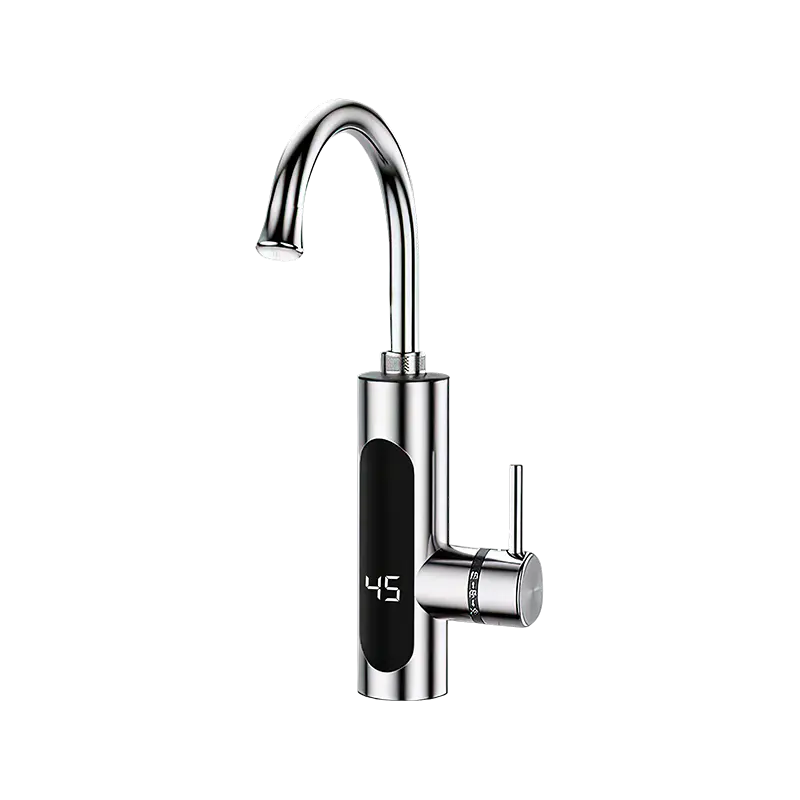 BSD-02X-34 Stainless Steel Instant Electric Kitchen FaucetFor hard daily kitchen use, this stainless steel instant heater faucet offers ceramic valve core, insulation mode and anti-dry-burning, anti-leakage and overheating protections.View Product →
The type most guides forget: where the hot water actually comes from
You can spend hours choosing between cartridge and ceramic disc and still be disappointed, because the real delay in most homes is not in the tap. It is in the pipe run between the water heater and the outlet.
There are four common arrangements, and they behave very differently.
1. Storage cylinder with a standard mixer
Hot water waits in a tank, usually some distance away. Every time you open the tap, the first litres in the pipe have cooled, so you run the tap and watch water disappear before warmth arrives. In a kitchen far from the cylinder this can be several litres per use. The tap itself is simple and cheap; the waste is in the pipe.
2. Central tankless heater with a standard mixer
A wall-mounted unit heats water on demand and feeds normal mixers. There is no standing tank, but there is still a pipe run, still a short delay, and still a minimum flow rate before the heater fires. Installation needs a suitable flue or a high-power electrical supply, which is a project-level decision rather than a tap-level one.
3. Small under-sink tank
A one to three litre tank sits in the cabinet and keeps a small reserve hot. It shortens the wait considerably and needs only a modest power supply. The limit is capacity: fine for washing hands and a few dishes, less so for filling a sink.
4. Instant electric heating faucet
The heating element is inside the tap body, so hot water is produced at the outlet. There is no tank, no recirculation and no cooled pipe volume, and the wait is measured in a few seconds rather than in litres wasted. Each outlet works independently, which suits kitchens, cloakrooms and small bathrooms where running a hot water pipe is disproportionate to the benefit.
The trade-offs are real and worth stating plainly. An instant electric tap needs a suitable power point nearby, typically rated around 3000 to 3400 watts for domestic models, on a circuit with earth leakage protection. It heats only as fast as the water flows, so the achieved temperature depends on flow rate and inlet temperature. And it makes no sense to install one directly beside a cylinder that already delivers hot water in two seconds.
If the run from the water heater to the outlet is longer than a few metres, a point-of-use instant electric faucet usually delivers hot water faster and with less wasted water than a bigger tank.
How one instant electric range spreads across faucet types
The chart below counts the models in a single manufacturer's catalogue and groups them by the type of faucet they are. It is a useful picture of where demand concentrates, and it shows how much of the range is built around the kitchen rather than the bathroom.
Model count by faucet type in one instant electric faucet range
ABS kitchen faucets
20
Stainless steel kitchen faucets
11
Quick free-installation faucets
7
Bathroom faucets
3
The kitchen group dominates for a straightforward reason: that is where the greatest number of separate hot water demands sit in a home, from washing vegetables to rinsing a greasy pan. Within that group, the ABS series spreads across features such as LED temperature display, over-temperature protection, leakage protection and 360-degree rotation, while the stainless steel series leans toward durability and higher perceived quality.
The quick free-installation group is the interesting one for retrofit work. These models connect to an existing supply without a full plumbing change, which makes them practical for rented flats, small offices and older buildings where nobody wants to open a wall. The bathroom group is smaller, but it covers the specific needs of wash basins, including corrosion-resistant stainless steel bodies and compact ABS designs with digital display.
For a buyer planning a container or a product line, this distribution is a reminder that the ABS kitchen tap is the volume product and the differentiator is in the details. Two models can share a body and differ only in whether they carry a thermostat, a dry-burn cut-out or a filter, and those differences decide which market they can be sold into.
Volume sits in kitchen models, but the margin and the market access sit in the feature differences inside that volume range.
Safety and electrical checks that only apply to heated taps
Once a tap contains a heating element, it stops being a purely plumbing product. The checks below are the ones that separate a competent instant electric faucet from a risky one, and they are the questions a serious supplier should be able to answer with documentation rather than assurances.
- Ingress protection rating. IPX4 indicates protection against splashing water from any direction, which is the realistic minimum for a tap mounted beside a sink. A model with no stated IP rating is a question mark, not a bargain.
- Earth leakage protection. A dedicated leakage protection device, either built into the plug or supplied as part of the circuit, is standard practice for wet electrical products. Models that advertise built-in leakage protection usually carry it in the plug or the control box.
- Over-temperature cut-out. A thermal switch that interrupts heating above a set temperature protects both the user and the element when flow drops unexpectedly.
- Dry-burn protection. If the element heats before water arrives, it destroys itself quickly. A flow or pressure switch that only allows heating when water is moving is essential, not optional.
- Thermostatic versus manual mixing. A manual tap blends hot and cold by handle position, so a change in inlet pressure alters the outlet temperature. A thermostatic model holds the outlet temperature close to the setting, which is a genuine safety benefit in households with children or older users.
- Cable, plug and circuit. Power ratings around 3000 to 3400 watts draw roughly 13 to 15 amps at 220 to 240 volts. A 10 amp socket is not adequate; check the plug type for the destination market, since British, European and other standards differ and cannot be adapted safely on site.
None of this makes an electric tap complicated to live with. It simply means the specification sheet should be read as an electrical document as well as a plumbing one, and that certification claims should match the market the product is sold into.
Flow switch, over-temperature cut-out and a stated IP rating are the three features that matter most, because together they stop the element heating when it should not.
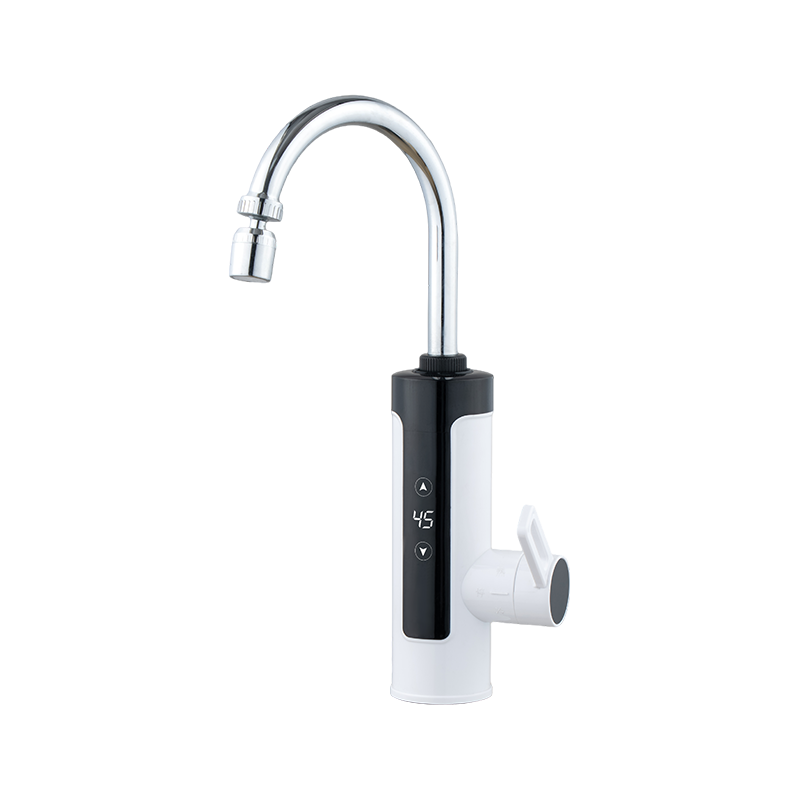 SS-10-34 Thermostatic Instant Hot Water Faucet with LED DisplayA real-time temperature sensor, large LED display and adjustment knob support constant outlet temperature; ABS housing and IPX4 rating suit kitchen use.View Product →
Matching the type to water conditions and the people using it
Two households can buy the same model and have opposite experiences, because water and users differ more than taps do.
Hard water and grit
Scale builds on heating elements and inside aerators. In an instant electric tap, scale on the element reduces heat transfer and eventually triggers the over-temperature cut-out, so the tap appears to stop working when it is really blocked. Choose models with a removable aerator and plan a descaling routine. Where sand or rust particles are present, an inlet strainer protects the ceramic plates as well as the element.
Pressure and flow
Instant heating depends on flow, so low pressure means less water and a higher achieved temperature, while high pressure pushes more water through and lowers it. Very high supply pressure is worth regulating for any tap, and for heated taps it also improves temperature stability.
A single lever with clear markings is easier to operate than two separate handles. A thermostatic model with a temperature limit stop reduces the chance of an accidental scald. In shared or rented accommodation, simple mechanical controls survive better than touch panels.
Retrofit situations
Where the plumbing cannot be altered, the quick free-installation type is the practical answer. These models clamp onto an existing supply point, often come with a choice of adapters and need no tile removal, which makes them attractive for landlords, small cafés and offices converting a cold-only tap into a hot one.
Water quality decides how long the tap lasts; the people using it decide which type is safe and comfortable. Both should be written down before a model is chosen.
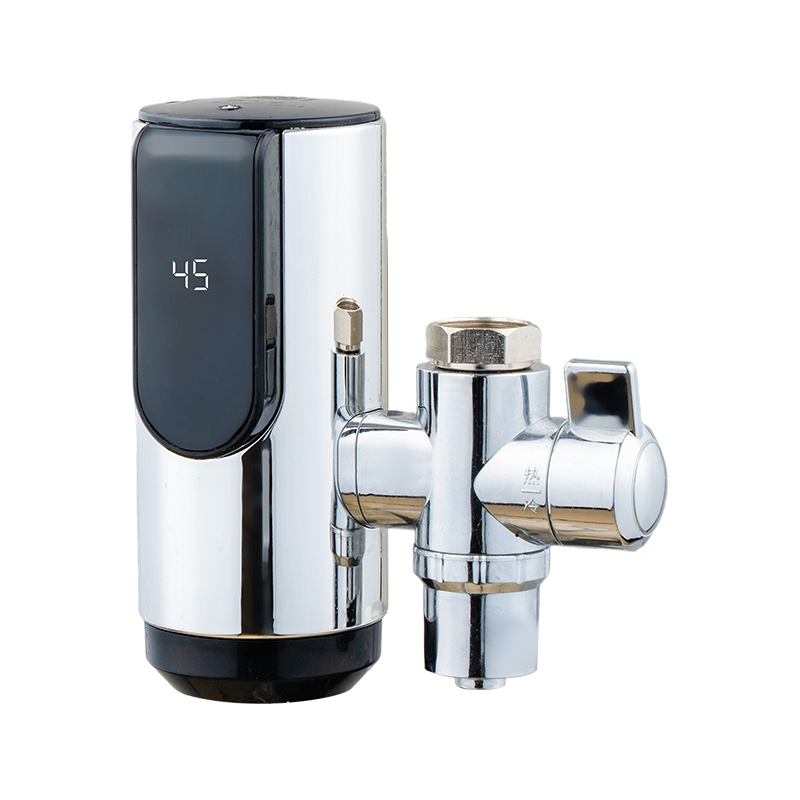 SJ-05-34 constant temperature ABS instant elctric free installation hot water faucet instaThe SJ-05-34 constant temperature ABS instant electric free installation hot water faucet instant electric heating water faucet. Its main part is white, with a silver ...View Product →
Specifying for a project: what distributors, contractors and OEM buyers should check
When a tap is bought one at a time, the decision is about the kitchen. When it is bought by the pallet, the decision is about documentation, consistency and what happens two years later when a cartridge fails in a customer's home.
| Item | What to confirm | Why it matters |
|---|---|---|
| Rated power and voltage | Wattage and 220 to 240 V or 110 V configuration | Circuit sizing and plug compatibility for the destination country |
| Plug and cable | Plug standard, cable length, leakage protection in plug | Cannot be adapted safely after shipment |
| Body and finish | ABS grade or stainless steel grade, plating thickness | Perceived quality, corrosion resistance in coastal markets |
| Valve and cartridge | Type, model number, availability as a spare part | Serviceability after the warranty period |
| Safety devices | Flow switch, over-temperature cut-out, dry-burn protection | Certification and liability |
| IP rating | Declared rating with test reference | Market acceptance and installation approval |
| Inlet connection | Thread standard and adapter set | Fit with local plumbing without field modification |
| Packing | Master carton quantity, inner box, language of manual | Handling cost and retail readiness |
Manufacturer, trading company or assembler
The distinction matters most at the repair stage. A factory that moulds, assembles and tests in one place can usually supply a matching cartridge, a replacement aerator or a spare plug two years later. A reseller that buys finished goods from several sources often cannot, and the buyer inherits the problem. Ask where the bodies are moulded, where the heating assemblies are made, and which quality checks happen between the two.
OEM and ODM reality
Custom work divides into two very different conversations. ODM means choosing from an existing range and applying your branding, packaging and documentation, which is fast and cheap. OEM means developing from a drawing or a sample, which needs tooling, sample approval rounds and a realistic lead time. Buyers who expect the second but budget for the first usually end up disappointed by the sample.
Certification and quality system
CE marking for European markets and an ISO 9001 quality management system are the baseline documents to request, alongside test reports for the specific models on order rather than for the factory in general. A quality system describes process discipline; a test report describes a product. Both are useful, and they are not substitutes for each other.
Spare parts and after-sales
For a wholesaler, the profitability of a faucet line is decided by the returns rate and the availability of cartridges, aerators and seals. Negotiate the spare parts list at the same time as the price list, and confirm which items ship free with the container.
A faucet supplier who cannot name the cartridge model and the plug standard in writing is a supplier who will not be able to support the product after delivery.
Common specification mistakes worth avoiding
Most failures in this category are not manufacturing failures at all. They are mismatches between a chosen type and the situation it was installed into. These eight show up repeatedly.
- Buying a bathroom-height tap for a kitchen sink, then discovering it splashes and cannot fill a pot.
- Ordering a heated tap without confirming the socket and circuit, then running it from a 10 amp outlet.
- Ignoring the deck hole diameter and deck thickness until installation day.
- Choosing a pull-out spray for a rental property where replacement hoses will never be sourced.
- Specifying chrome everywhere, then dealing with water spot complaints in a hard water area.
- Installing an instant electric tap right next to a cylinder that already delivers hot water quickly.
- Buying on price without checking whether the cartridge is available as a spare.
- Accepting a plug standard that does not match the destination market and planning to "sort it locally".
Every item on this list costs more to fix after installation than it costs to check before ordering.
Where to look next
Two pages that answer the questions buyers ask most often after choosing a type:
- Instant electric water heating faucet range for the full model overview by material and installation type.
- Are instant electric bathroom faucets safe? for the electrical and installation questions in more detail.
Read the product family page first and the safety page second; the second only makes sense once you know which model you are considering.
FAQ: types of faucets
How many types of faucets are there?
There is no fixed number, because the word "type" refers to different layers. Four valve designs cover most residential products, roughly eight to ten mounting arrangements are in common use, and there are at least four ways of supplying hot water. Multiply those layers and you get hundreds of combinations, but any single tap is described by only one option from each layer.
Which valve type lasts the longest?
In clean water, ceramic disc valves generally outlast the other three because there are no rubber washers to perish and the plates stay flat. In gritty water the advantage shrinks, since particles can score the plates. A cartridge valve in a clean supply with a replaceable cartridge is often the most practical long-term choice, because the failure is cheap to fix.
Is an instant electric faucet a faucet or a water heater?
Both. It is a tap with a heating element and a control circuit inside the body, so it replaces the tap and the pipe run to the heater at the same time. That is why it is assessed on plumbing, electrical and safety criteria together rather than as a simple fitting.
What power supply does an instant electric faucet need?
Most domestic models are rated around 3000 to 3400 watts at 220 to 240 volts, which means a dedicated circuit with earth leakage protection rather than a shared socket. Lower power models exist for markets with 110 volt supply, and they deliver less hot water per minute, which matters when sizing for a kitchen.
Can a wall-mounted tap replace a deck-mounted one?
Only with building work. The body has to be supported inside the wall and the supply pipes have to be brought to that point, so the change involves opening the wall, adding blocking and re-finishing. If the deck hole is already there, replacing a deck-mounted tap with another deck-mounted tap is a task measured in minutes.
Do I need a thermostatic tap in a kitchen?
It is not essential, but it is useful where children use the sink, where inlet pressure fluctuates, or where the same outlet serves both handwashing and food preparation. A thermostatic model holds the outlet temperature close to its setting instead of drifting with pressure changes, which reduces the chance of an unexpected hot burst.
What is the difference between a cartridge and a ceramic disc?
A ceramic disc valve uses two ceramic plates sliding against each other. A cartridge is a sealed unit that usually contains ceramic plates or a ceramic and rubber combination, and it is replaced as a whole. In everyday language the terms overlap; in repair terms the cartridge is the part you order when the tap starts to drip.
What should a wholesaler check before ordering a container of faucets?
Confirm the plug standard and rated voltage for the destination market, the IP rating and safety devices on heated models, the model number of the cartridge and how to reorder it, the master carton quantity, and the language of the instruction manual. Then request test reports for the exact models on the order, not for the factory's general capability. A manufacturer who answers all of that in writing is usually the one worth a second order.
Almost every question about types of faucets reduces to three answers: which valve, which mounting, and where the hot water comes from.
The temptation with faucet types is to start with the showroom and work backwards. It is more reliable to start with the outlet: what the tap must do, where it is fixed, and how the hot water reaches it. Once those three answers exist, the choice narrows to a handful of models and the remaining discussion, about finish and handle shape, becomes genuinely about taste rather than about risk.
For a household, that means deciding whether a point-of-use heated tap removes a daily annoyance or solves a problem that does not exist. For a distributor or contractor, it means asking a faucet manufacturer the awkward questions about cartridges, plug standards and test reports before the order, not after the first return.
Get the valve, the mounting and the heat source right, and the tap you choose will still feel like the right decision years after the showroom has moved on to a new shape.
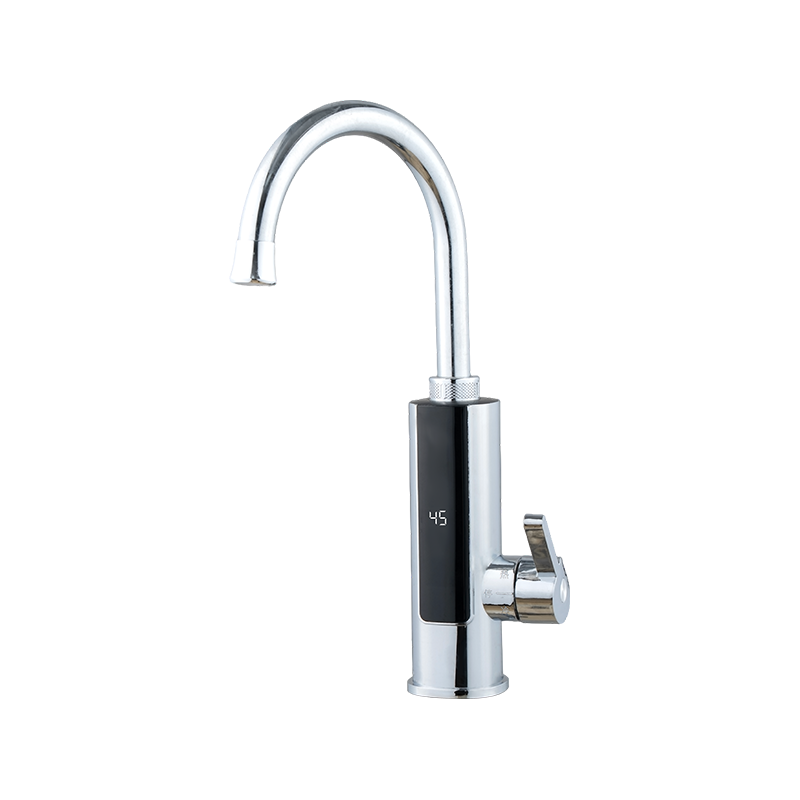
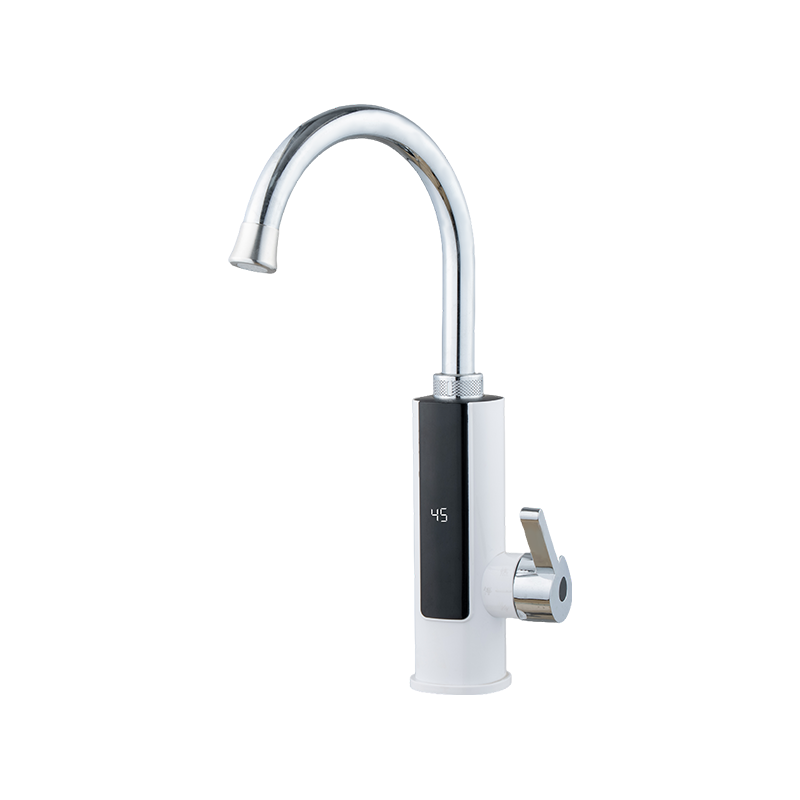
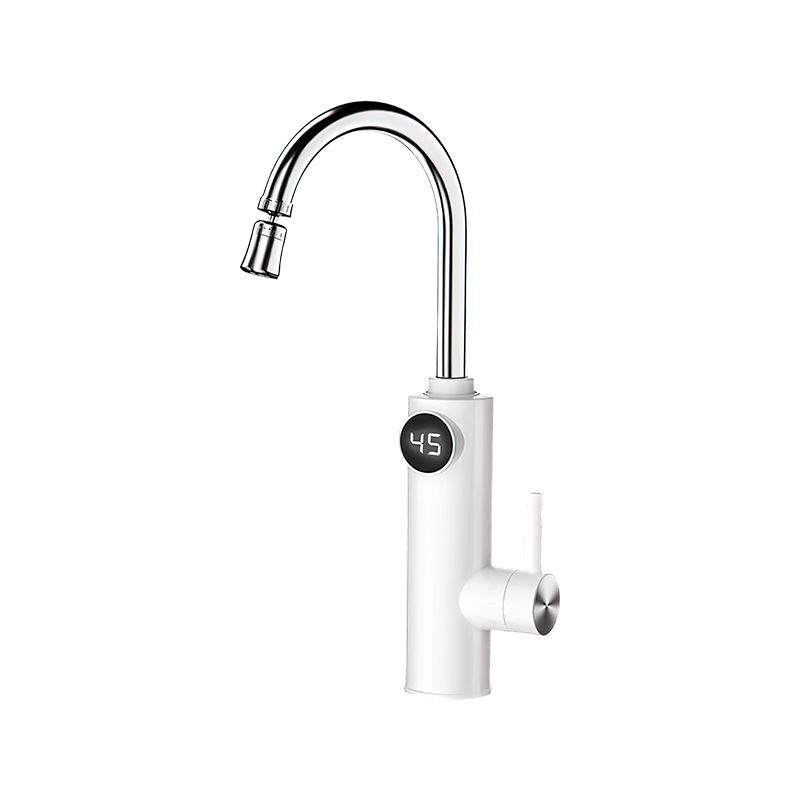



NINGBO MAITENG ELECTRIC APPLIANCE CO., LTD. integrates production and sales. The company adopts a dual model of self-management and distribution sales.
- CONTACT INFO
-
NO.8 Yaobei Avenue,Simen Town, Yuyao City, Ningbo City, Zhejiang, China
-
 +86-159 5821 2132
-
 +86-574-62178444
-
 +86-159 5821 2132
-
 [email protected]
-
- SCAN IT
-
Mobile terminal

