


 English
 Español

How to Remove Calcium Deposits From a Faucet: A Practical Cleaning Guide
Date:2026-11-02
Content
- 1 Why Calcium Deposits Keep Coming Back
- 2 Before You Start: Materials, Finish Checks and Two Safety Rules
- 3 How to Remove Calcium Deposits From a Faucet, Step by Step
- 4 How Long Each Descaler Actually Needs
- 5 Vinegar, Citric Acid or a Commercial Descaler: A Practical Comparison
- 6 The Parts Most People Forget
- 7 What Not to Do When Removing Scale
- 8 When Scale Is a Symptom, Not the Problem
- 9 Prevention That Actually Works
- 10 What Buyers, Distributors and Wholesalers Should Ask a Manufacturer
- 11 Frequently Asked Questions
- 11.1 How do I remove calcium deposits from a faucet without vinegar?
- 11.2 Does vinegar damage chrome faucets?
- 11.3 How often should a faucet be descaled?
- 11.4 Why does the scale come back within a week?
- 11.5 Can I use bleach or a mould spray near the tap?
- 11.6 Do instant electric faucets need descaling?
- 11.7 What hardness is too hard for a tankless tap?
- 11.8 Is it a problem to leave the aerator off after cleaning?
A faucet announces a calcium problem long before the white crust becomes obvious. The stream starts splitting into two thin jets instead of one, a chalky ring appears on the sink every morning, and the handle feels slightly gritty at the last quarter turn. In most homes that crust is calcium carbonate, often mixed with magnesium salts, silica and soap residue, and it comes off with a mild acid, a bit of time and a soft brush.
The short answer is to soak, not scrape. A 20 to 30 minute soak in white vinegar diluted 50/50 with warm water, or in a citric acid solution, softens the deposit enough that a soft toothbrush lifts it away in a few passes. Anything harder than a plastic brush, such as a knife tip, a screwdriver or steel wool, removes the chrome along with the scale and leaves scratches where the next layer of scale grips even faster.
We build instant electric water faucets, the type that heats water inside the tap body within a few seconds, so we meet calcium from two directions. At home it is the same crust on the same chrome. Inside a product it becomes a heat transfer problem, where a fraction of a millimetre on a heating surface changes how the element runs and how long it lasts. This guide covers the cleaning method first, then the parts most people forget, then the design and purchasing decisions that stop scale from turning into a warranty issue.
Why Calcium Deposits Keep Coming Back
Rainwater absorbs carbon dioxide as it falls and becomes a weak acid. As it moves through limestone and chalk it dissolves calcium and magnesium, which stay in solution as bicarbonates. Nothing visible happens until the water is heated, agitated or simply left to evaporate. Heat drives the carbon dioxide out and the bicarbonate converts to carbonate, which has very low solubility and settles out as a fine white solid. That is the crust.
Two things make a faucet the perfect place for this to happen. First, the hot side of the tap is the warmest point in the plumbing, and the precipitation rate climbs quickly with temperature. Water that leaves no trace in a cold glass can leave a film after passing through a 3000W heating chamber. Second, the spout tip and the aerator are where water drips dry. Every slow drip leaves a microscopic ring of solids behind, and those rings build up layer by layer until the aerator screen is half blocked.
Hardness is measured in milligrams per litre of calcium carbonate, which is the same number as parts per million. Some suppliers still quote grains per gallon, where one grain equals about 17.1 mg/L, and European data sheets often use German degrees, where one degree equals 17.8 mg/L. The bands below are the ones most water utilities publish, and the right-hand column describes what our after-sales team hears from users rather than a laboratory definition.
| Hardness (mg/L as CaCO3) | Common label | What you tend to see at the tap |
|---|---|---|
| 0 to 60 | Soft | Almost no film; an annual wipe is usually enough |
| 61 to 120 | Moderately soft | Light spotting on chrome, aerator clear for months |
| 121 to 180 | Hard | Visible film within two to three weeks, aerator needs cleaning quarterly |
| 181 to 250 | Very hard | Chalky crust at the spout, reduced flow, scale on heating surfaces |
| Above 250 | Extremely hard | Fast crusting, dripping spouts, noticeably shorter element life in tankless products |
If you do not know your number, your water supplier publishes it, and a 10 euro test strip will give you a rough figure in a minute. It is worth knowing, because the difference between 140 mg/L and 320 mg/L is the difference between descaling twice a year and descaling every month.
Scale forms fastest where water is hottest and where it drips dry, which is why the spout tip and the aerator always show it first.
Before You Start: Materials, Finish Checks and Two Safety Rules
Five minutes of preparation prevents most of the damage people blame on vinegar. Check the finish first. Chrome, brushed nickel, PVD coatings and 304 stainless steel all tolerate short acid contact well. Painted or plated ABS plastic, which is what many modern instant hot taps use for the body shell, tolerates it too, but long soaks dull the surface and can lift printed temperature markings. Natural stone worktops are the real risk: a splash of acid etches marble and travertine permanently, so move the cloth, do not just wipe afterwards.
- White vinegar, 5 to 8 percent acetic acid, the cheapest option for chrome and stainless steel
- Citric acid powder, roughly two tablespoons per 250 ml of warm water, for taps with plastic parts or for people who dislike the smell
- A small resealable bag and a rubber band, or a strip of cloth and tape, to keep the descaler in contact with the spout
- A soft toothbrush, a plastic scraper and a wooden toothpick, no metal tools
- Microfibre cloth, plus a dry towel for the surrounding deck
- Adjustable wrench or aerator key if the screen has to come out
The first safety rule is never to mix an acid descaler with chlorine bleach or a bleach-based bathroom spray. Acid plus hypochlorite releases chlorine gas, and a small bathroom with the door closed is exactly the wrong place for it. Rinse thoroughly between products, or better, use one product at a time and finish with clean water. The second rule is that more acid is not better. A 50/50 vinegar mix works as well as full strength on a normal crust and is far gentler on seals, O-rings and finishes. Strength mainly shortens the dwell time, and dwell time can be managed with a bag and a timer.
One more practical note: if the tap has a pull-out spray head, a flexible hose or an electronic display, do not submerge the body. Wrap the affected area only, keep the electronics dry, and use a cloth dampened with descaler rather than a running bag.
Never combine an acid descaler with bleach, and never let acid pool on natural stone or on an electronic tap body.
How to Remove Calcium Deposits From a Faucet, Step by Step
The sequence below is the one we recommend to end users and to the service partners who handle our taps in the field. It takes 30 to 60 minutes of clock time and about 10 minutes of actual work.
- Identify the finish and the material of the body, spout and aerator before touching anything.
- Close the supply valve under the sink if you plan to remove the aerator or the spout tip.
- Mix the descaler: equal parts white vinegar and warm water, or two tablespoons of citric acid per 250 ml of warm water. Warm, not boiling.
- Fill the small bag with the mix and tie it around the spout so the crusted area is fully immersed. On a wide body, wrap a soaked cloth instead.
- Wait 20 to 30 minutes. For a thick crust, re-wet the cloth at the halfway point and extend to 60 minutes.
- Remove the bag and scrub gently with the soft toothbrush, working along the seam and around the spout lip.
- Use the wooden toothpick or plastic scraper only on stubborn edges, and only at a shallow angle.
- Flush with clean water and run the hot side for 30 seconds to clear loosened particles from the passages.
- Unscrew the aerator, soak it separately for 15 minutes, backflush it under the tap, and pin out any remaining grit with a toothpick.
- Dry the body with a microfibre cloth and inspect. If a hard ring remains, repeat the next day rather than scrubbing harder today.
Steps 4 and 5 do most of the work. The mistake people make is scrubbing first, which removes the loose top layer and polishes the hard base into a smooth, transparent film that is much harder to dissolve. Soaking from the outside in keeps the acid in contact with the whole deposit at once.
Step 9 matters more than it looks. A clogged aerator is the single most common reason a tap appears to lose pressure after descaling, because loosened scale travels up into the screen and stays there. If the mesh is deformed or the plastic housing is cracked, replace the aerator instead of cleaning it. It is an inexpensive part and it protects the cartridge from debris.
For taps with a ceramic cartridge, stiff operation after cleaning usually means scale reached the cartridge barrel rather than the spout. Remove the handle, take out the cartridge, soak it for 20 minutes in the citric acid mix, rinse, and lubricate the O-rings with silicone grease. Petroleum jelly swells many rubber compounds and should stay away from potable water fittings.
Soak for 20 to 30 minutes first and scrub second; reversing that order polishes the scale into a film that acid struggles to reach.
How Long Each Descaler Actually Needs
Contact time matters more than acid concentration, and the difference between products is mostly about how quickly they soften a typical half-millimetre crust. The chart below shows the starting dwell time we suggest for each option, before any scrubbing is attempted.
Suggested starting dwell time by descaler type (minutes)
Commercial gel descaler
10
Citric acid, 2 tbsp per 250 ml
20
Vinegar and water, 50/50
30
White vinegar, full strength
40
Heavy crust, any descaler
60
Commercial descalers are quicker because they are formulated as gels that cling to a vertical surface instead of running off, and because they often combine a mild acid with a surfactant that lifts the softened layer. That convenience has a price per treatment, and some formulations are strong enough to dull plated plastic if left too long, so the label instructions should be treated as a maximum rather than a suggestion.
Vinegar is the cheapest option per litre and works well on chrome and stainless steel, but it is slow and the smell lingers in a small bathroom. Rinsing with warm water and leaving the extractor fan on for ten minutes deals with it. Citric acid sits between the two: it works faster than vinegar at the same concentration, has almost no odour, and is gentle on the ABS bodies and LED windows used on many instant hot taps, which is the reason we specify it in our own cleaning guidance.
For taps with internal filtration, such as models that combine a carbon or mesh filter with the heating path, descaling the outside is only half the job. The filter housing should be opened and the element rinsed according to the manual, because scale that forms upstream of the filter media slowly blinds it and reduces flow even when the spout looks spotless.
Choose the descaler by what the tap is made of, then control the result with dwell time rather than with a stronger acid.
Vinegar, Citric Acid or a Commercial Descaler: A Practical Comparison
Most households already own one of these three, so the decision is usually about which one to reach for given the finish, the smell and the time available. The table compares them on the factors that actually change the outcome.
| Option | Typical mix | Contact time | Best suited to | Watch out for |
|---|---|---|---|---|
| White vinegar | 1:1 with warm water | 30 minutes | Chrome, stainless steel, aerator screens | Strong odour, slow on thick crust |
| White vinegar, full strength | Straight from the bottle | 40 minutes | Old fixed taps with heavy build-up | Can dull plated plastic over repeated soaks |
| Citric acid | 2 tbsp per 250 ml warm water | 20 minutes | Taps with ABS bodies, displays and seals | Powder must dissolve fully before use |
| Commercial gel descaler | Ready to use | 10 minutes | Vertical surfaces, quick maintenance | Higher cost, follow the label maximum |
| Mechanical removal only | No chemicals | Not applicable | Loose flakes after a soak | Scratches chrome if anything metal is used |
Cost is worth a quick calculation. A litre of white vinegar costs a fraction of a bottle of branded descaler and treats dozens of taps, while a 500 g bag of citric acid powder makes roughly 10 litres of working solution. For a household with three or four outlets and hard water, that is a year of descaling for very little money. The commercial gel earns its price when speed matters, for example in rental turnover or in a commercial kitchen where a tap cannot be out of service for an hour.
There is one situation where the choice is made for you: if the manufacturer's manual names a specific descaler or forbids vinegar, follow the manual. Warranty terms often hinge on documented maintenance, and a service centre can usually tell whether a corroded seal was caused by neglect or by an aggressive chemical left in contact for hours.
Citric acid is the safest default for modern taps with plastic bodies and electronic displays, while vinegar remains the best value on plain chrome.
The Parts Most People Forget
The visible crust is rarely the whole story. Calcium collects in five places on a typical tap, and cleaning only the spout means the problem returns within weeks.
The Aerator and Its Screen
Unscrew the aerator by hand or with a key, soak it for 15 minutes, then backflush it under a running tap in the reverse direction to the normal flow. Grit that has been pushed into the mesh from the supply side will not come out with forward flushing. If the mesh has lost its shape, replace the whole aerator. A deformed screen disturbs the flow pattern and makes the tap splash, which people often mistake for a pressure problem.
The Spout Tip and the Seam
Where the spout meets the body there is usually a seam or a small gap. Water sits there, evaporates, and leaves a hard ring that a cloth cannot reach. A soaked cloth wrapped around the joint for 20 minutes, followed by a soft brush, clears it without prying. Never insert a blade into the seam to lift scale; the plating is thinner there than anywhere else on the tap.
The Deck and Base Ring
Around the base, calcium combines with soap and hand cream to form a grey-white ring that feels like set plaster. Lay a cloth soaked in citric acid solution flat around the base for 15 minutes, then wipe with a microfibre cloth. Keep the cloth small so the acid does not spread to a stone worktop, and rinse the area with clean water afterwards.
The Cartridge and Valve
A handle that becomes stiff or squeaky is often a scaled cartridge rather than a worn one. Removal takes a screwdriver and a few minutes: prise off the index cap, unscrew the retaining ring, pull the cartridge, soak it, rinse, grease the O-rings with silicone and refit. If the tap drips after refitting, the cartridge seats are probably still crusted and need a second soak.
The Heating Chamber in an Instant Hot Tap
Inside a tankless electric tap there is no aerator to unscrew and no cartridge to soak. Water passes over a heated metal or ceramic surface, and scale deposits there directly reduce heat transfer. Many sealed units are not designed for user descaling, which is why prevention through filtration and sensible temperature settings matters more in this category than in any other.
If you clean only the spout, you have cleaned roughly half the calcium in the tap.
What Not to Do When Removing Scale
Most damaged faucets we see in service were not damaged by water. They were damaged by a well-intentioned cleaning session. These are the habits worth avoiding.
- Do not scrape with a knife, flathead screwdriver, wire brush or steel wool; all of them cut through chrome and leave a scratch pattern that catches scale faster.
- Do not mix vinegar or citric acid with bleach, chlorine tablets or bleach-based sprays.
- Do not leave acid in contact for hours "to be thorough". One hour is generous; overnight soaks attack seals and printed markings.
- Do not use boiling water with acid; thermal shock can crack ceramic cartridges and distort plastic housings.
- Do not pour descaler into a pressurised heater or a sealed instant unit that the manual does not list as serviceable.
- Do not use abrasive cream cleaners on brushed nickel; they flatten the brushed grain and leave a shiny patch.
- Do not ignore a persistent drip after descaling; a scaled or worn seal will re-scale the same spot within days.
Baking soda deserves a separate mention because it appears in almost every cleaning list. It is a mild abrasive and a decent deodoriser, but it is not a descaler. Calcium carbonate dissolves in acid, not in a base. A bicarbonate paste will polish away a soft film and is useful for soap scum on the deck, yet it will not touch a hard ring at the spout. Use it after descaling, not instead of it.
Any tool harder than plastic costs more in refinishing than a bottle of descaler costs to buy.
When Scale Is a Symptom, Not the Problem
On a conventional tap, calcium is cosmetic and occasionally mechanical. On an instant electric faucet it is thermal. The heating surface runs hotter than the water leaving the spout, because heat has to cross the wall of the chamber and then the scale layer. Calcium carbonate conducts heat roughly a hundred times less effectively than steel, so a 0.5 mm layer is not a stain, it is insulation.
What that means in practice is a slow, quiet decline. Water takes longer to reach temperature, the outlet temperature drifts a few degrees lower than the setting, the thermostat cycles more often, and the element runs hotter to compensate. None of these symptoms look dramatic on their own, which is why users often describe the tap as "getting old" rather than as scaled. In very hard water areas the process can compress element life noticeably within two or three years of daily use.
Design choices make a difference here, and they are worth asking about when comparing products. A stainless steel heating tube with a smooth bore sheds scale differently from a rough casting. Wide internal passages tolerate a certain amount of build-up before flow drops. Dry-burn protection and over-temperature cut-outs protect the element when scale has already reduced heat transfer. Removable aerators make routine maintenance possible without tools, and internal filtration keeps grit from reaching the chamber in the first place.
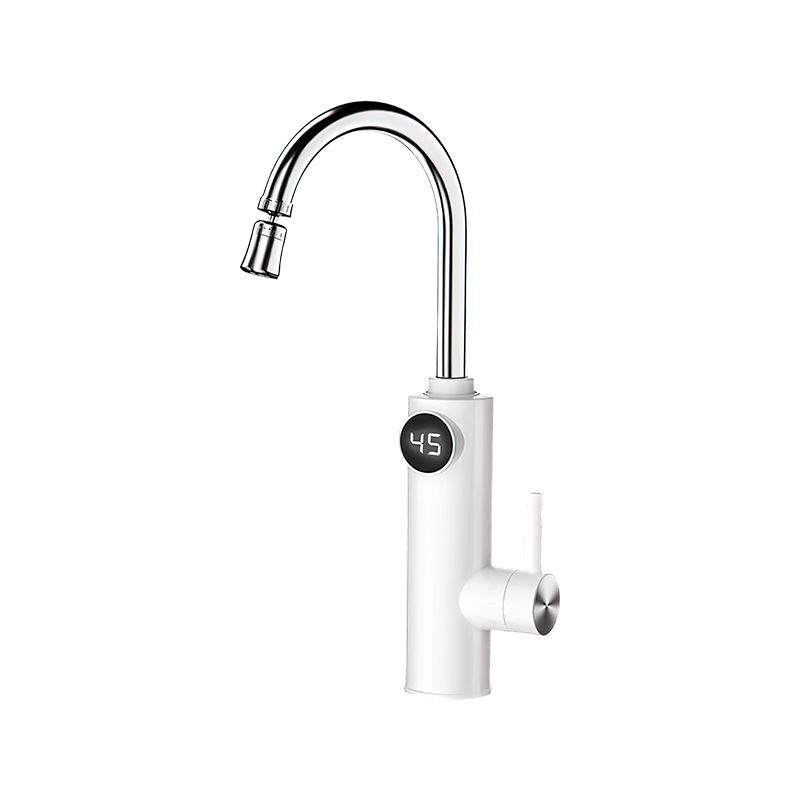
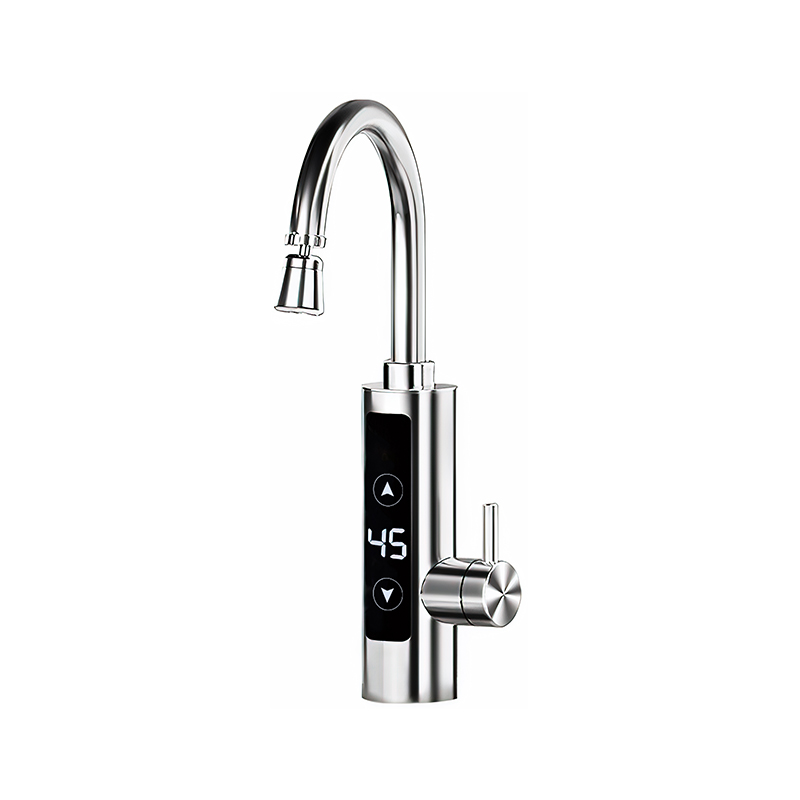 BSDF-01X-34 Stainless Steel Digital Instant Hot Water FaucetStainless steel instant faucet with dry-burn protection and digital temperature display, suited to hard-water kitchens where a visible readout helps flag scale buildup.View Product →
That combination of a stainless steel body, dry-burn protection and a digital display is what most of our hard-water customers end up choosing, because it gives them a visible temperature readout as an early warning: when the displayed outlet temperature starts lagging behind the set value, it is time to check for scale rather than to replace the tap.
Symptoms that deserve attention rather than a descaler include water that smells of hot plastic, a display that flickers when the heater engages, and a body that becomes noticeably warm to the touch on the outside. Those point to an electrical or sealing issue, and we cover the safety side of instant heating in more detail in our article on how instant heating is built for safe, worry-free use. Descaling will not fix any of them.
On a tankless electric tap, a temperature reading that no longer reaches its set point is usually scale before it is a fault.
Prevention That Actually Works
Cleaning removes what has already formed; prevention decides how often you repeat the job. In hard water areas, the honest answer is that no tap design eliminates calcium. What good design and good habits do is slow the rate enough that descaling stays a seasonal task instead of a monthly chore.
- Fit a water softener or an ion exchange cartridge if hardness is above 250 mg/L; this is the only measure that addresses the cause rather than the symptom.
- Wipe the spout and deck dry once a day with a microfibre cloth; removing the droplet removes the ring.
- Run the cold side briefly after using the hot side so the chamber does not sit full of hot, concentrating water.
- Clean the aerator every three months in hard water, every six months in soft water.
- Keep the outlet temperature at the lowest setting that is comfortable; every extra degree accelerates precipitation.
- Replace tired aerators and washers early rather than accepting a drip that leaves a deposit overnight.
- Use a point-of-use filter where grit and sediment are part of the problem, particularly on older supply lines.
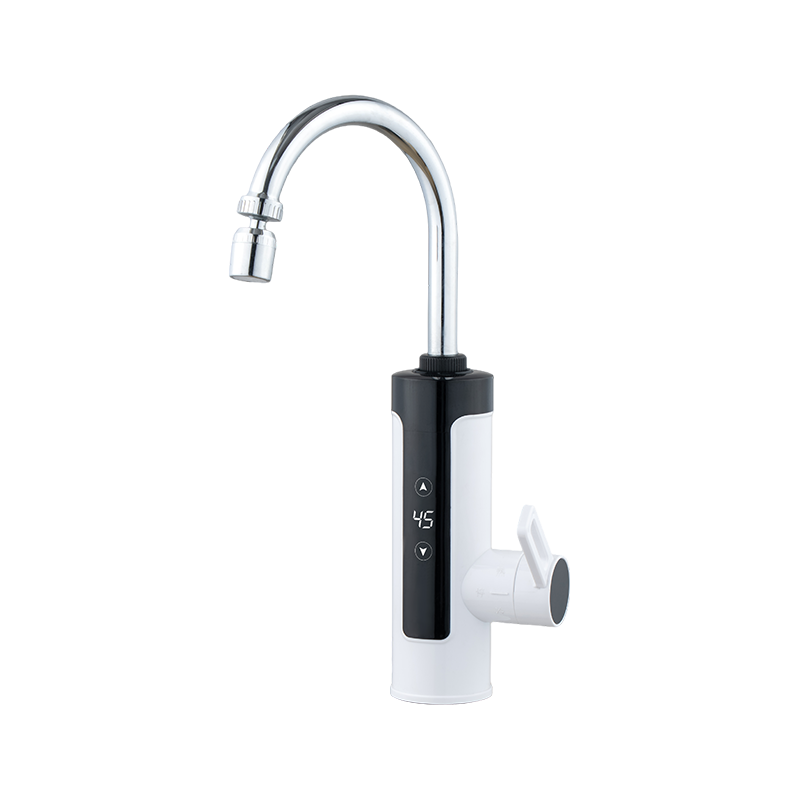
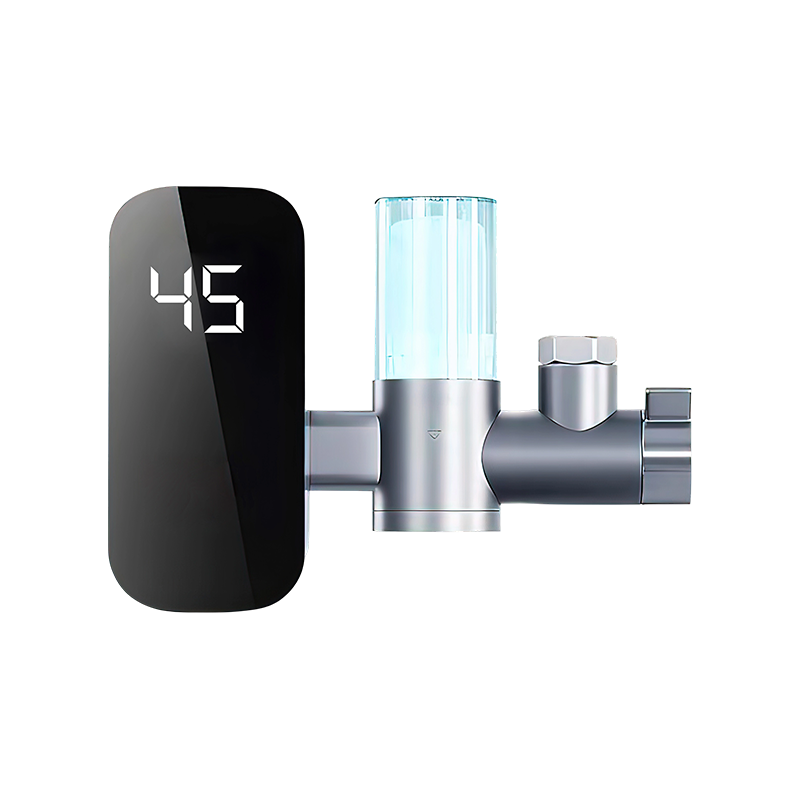 GD-04-34 ABS Kitchen Heating Tap with Built-in FiltrationCompact ABS instant-heating kitchen tap with a six-layer built-in filter that catches sediment before the heating path, making scheduled cartridge changes part of routine maintenance.View Product →
A built-in filter cartridge changes the maintenance rhythm rather than removing it. It catches sediment before the water reaches the heating path, so the chamber sees cleaner water, and it gives the user a component that is designed to be changed on a schedule. In households where the tap is used twenty times a day for washing vegetables and filling pans, that schedule is easier to keep than an occasional deep clean.
One useful advantage of tankless electric products in this context is that there is no stored hot water. There is no tank to accumulate sediment at the bottom, no anode rod to inspect, and no large warm volume where bacteria can sit. All the scale risk is concentrated in a small, fast-flowing chamber, which makes the maintenance question simpler: keep the water clean going in, and watch the outlet temperature for the first sign of build-up.
Removing the droplet before it dries does more for a tap than any single deep clean.
What Buyers, Distributors and Wholesalers Should Ask a Manufacturer
For anyone sourcing instant hot water faucets rather than cleaning one, calcium resistance is a specification item, not a marketing phrase. Hard water is common across southern Europe, the Middle East, parts of North Africa, northern China and large areas of North America, and a product that performs well in a soft water showroom can generate a stream of complaints in a hard water market.
Questions worth putting in writing include the material and surface finish of the heating tube, the internal passage dimensions, whether the aerator is user removable and available as a spare part, what over-temperature and dry-burn protection is fitted, the IP rating of the electrical enclosure, and whether the unit has been life-tested with hard water rather than with demineralised water. A supplier that can answer these specifically, rather than repeating a general quality claim, is usually the one with real production experience behind the answer.
- Certification and consistency: ISO 9001 procedures, CE documentation, and a stated incoming inspection routine for heating components
- Spare parts policy: aerators, cartridges and filter elements available for the life of the model
- OEM and ODM capability: whether tooling and housings can be adapted to a brand's own design language
- Capacity and lead time: monthly output, moulding capacity and packing capability during peak season
- Warranty terms that separate cosmetic scale from a functional fault, so claims are decided on evidence
- Labeling and manuals that state a descaling method suitable for the actual materials used
We are a manufacturer of instant electric water faucets based in Ningbo, with a 10,000 square metre plant, around 200 staff and an annual capacity of about two million units, producing for our own brands and for OEM and ODM partners. Products are covered by ISO 9001 and CE, and the range spans ABS and stainless steel kitchen taps, bathroom models and quick free installation designs, from 3000W single-handle units to thermostatic models with LED displays, leak protection and built-in filtration. For wholesale and distribution enquiries, our contact page is the fastest route to a specification discussion and a quotation.
Where to go next
- Technical background on safe instant heating: how instant heating is designed for worry-free daily use
- For pricing, samples and OEM discussion: send us your specification
Frequently Asked Questions
These are the questions our support team and distributors ask most often about calcium on faucets, including the ones that come up specifically for instant electric models.
How do I remove calcium deposits from a faucet without vinegar?
Use citric acid: about two tablespoons of powder dissolved in 250 ml of warm water, applied with a soaked cloth or a tied bag for 20 minutes. A commercial gel descaler works too, usually faster, and is the better choice on vertical surfaces where a liquid runs off. If you have no acid at all, a long warm water soak plus a plastic scraper will shift soft surface film but will not dissolve a hard ring.
Does vinegar damage chrome faucets?
Short contact does not. Thirty to sixty minutes of diluted white vinegar on chrome or stainless steel is well within normal tolerance, and rinsing afterwards removes the residue. Problems come from overnight soaks, from full-strength acid left to pool around a plated plastic base, and from acid splashed onto natural stone. On printed or painted plastic parts, use citric acid instead and keep the contact time under 30 minutes.
How often should a faucet be descaled?
In water above 180 mg/L, every four to eight weeks for the visible parts and every three months for the aerator. Between 120 and 180 mg/L, quarterly is usually enough. Below 120 mg/L, once or twice a year, plus a wipe-down routine, keeps most taps clean. Watch the flow and the spout surface rather than the calendar; those two indicators tell you when the interval needs shortening.
Why does the scale come back within a week?
Usually because the tap still drips. A slow drip leaves a fresh deposit every hour, and no descaler can keep up with that. Replace the washer or cartridge, dry the spout after each use, and check whether the aerator is spraying slightly sideways, which leaves water on the body instead of in the sink.
Can I use bleach or a mould spray near the tap?
Bleach is fine for silicone joints and tiles, but never at the same time as an acid descaler. Acid plus hypochlorite produces chlorine gas. Rinse and dry the tap thoroughly before switching products, and ventilate the room. Bleach also attacks some rubber seals over time, so it should not be left sitting on the tap body.
Do instant electric faucets need descaling?
Yes, and the internal chamber matters more than the spout. Where the manual allows it, a citric acid flush through the heating path once or twice a year helps. Where the unit is sealed, the practical approach is prevention: filtration on the inlet, sensible temperature settings, and attention to a temperature display that stops reaching its set value.
What hardness is too hard for a tankless tap?
There is no universal cut-off, because element design, wattage and usage pattern all matter. Above roughly 250 mg/L, we recommend inlet filtration or softening as part of the installation, and buyers in those markets should specify hard-water life testing. Below 120 mg/L, scale is mostly a cosmetic issue on the spout and aerator.
Is it a problem to leave the aerator off after cleaning?
It is not dangerous, but it is not advisable. Without an aerator the stream splashes, flow rate rises and water use increases, and on many models the aerator also holds the spout insert in place. Refit it after soaking, and replace it if the mesh is deformed rather than leaving the tap without one.
Flow rate, spout appearance and outlet temperature are the three indicators that tell you when to descale, and they are more reliable than any fixed schedule.
Calcium on a faucet is a predictable problem with a predictable solution. Soak the crust in a mild acid for 20 to 30 minutes, scrub with something soft, clear the aerator separately, and dry the tap afterwards. Repeat the next day rather than reaching for a sharper tool. In hard water, add a wipe-down habit and a descaling interval based on what the flow and the surface are telling you, and the same tap will stay bright for years instead of months.
For appliances that heat water inside the body, the same routine protects something more expensive than a finish. A clean heating path keeps outlet temperature stable, keeps the element within its design range and keeps warranty conversations short. Whether you are descaling a kitchen tap at home or specifying a container load of instant hot water faucets for a hard water market, the principle is identical: control the water going in, watch the temperature coming out, and deal with the first sign of scale before it becomes a service call.



NINGBO MAITENG ELECTRIC APPLIANCE CO., LTD. integrates production and sales. The company adopts a dual model of self-management and distribution sales.
- CONTACT INFO
-
NO.8 Yaobei Avenue,Simen Town, Yuyao City, Ningbo City, Zhejiang, China
-
 +86-159 5821 2132
-
 +86-574-62178444
-
 +86-159 5821 2132
-
 [email protected]
-
- SCAN IT
-
Mobile terminal

