


 English
  Español
ABS Instant Electric Kitchen Faucet: Types, Materials & Buying Guide
Date:2026-08-17
Content
- 1 Instant Electric Kitchen Faucet (ABS): The Direct Answer for Buyers
- 2 Common Types and Features of ABS Instant Electric Kitchen Faucets
- 3 Why Manufacturers Choose ABS: Structure and Material Principle
- 4 Material Comparison: ABS Housing vs Stainless Steel Housing
- 5 Selecting the Right ABS Kitchen Faucet for Your Project
- 6 Demand Trend for ABS Finish Kitchen Faucets
- 7 Buyer Preference for ABS in Budget-Focused Kitchen Projects
- 8 Feature Configuration Mix Across ABS Kitchen Faucet Model Lines
- 9 Installation Guidelines and Safety Considerations
- 10 Maintenance Guidance for ABS Kitchen Faucets
- 11 Choosing a Reliable ABS Kitchen Faucet Manufacturer
- 12 Frequently Asked Questions
- 12.1 Q1: Is ABS plastic safe to use around an electric heating element in a faucet?
- 12.2 Q2: Does an ABS kitchen faucet look different from a stainless steel one?
- 12.3 Q3: What voltage options are available for ABS instant electric kitchen faucets?
- 12.4 Q4: Is ABS durable enough for daily kitchen use?
- 12.5 Q5: What safety features should buyers look for in an ABS kitchen faucet?
- 12.6 Q6: Can manufacturers supply ABS kitchen faucets as OEM or private label products?
Instant Electric Kitchen Faucet (ABS): The Direct Answer for Buyers
An instant electric Kitchen faucet (ABS) is a kitchen-mounted, tankless hot water tap that uses an ABS plastic housing around the internal heating chamber instead of a metal body, which keeps the unit light, naturally non-conductive, and generally lower cost to produce at scale. For buyers comparing housing materials, the short answer is that ABS is chosen for electric kitchen faucets because plastic does not conduct electricity, resists everyday kitchen moisture and mild cleaning agents without rusting, and can be molded into curved gooseneck spouts and electroplated finishes that would be harder and more costly to achieve consistently in metal. This makes ABS a practical, widely used housing choice for entry to mid-range kitchen units where installation speed, safety insulation, and manufacturing cost per unit all matter to the buyer.
This guide covers the common configurations of ABS instant electric kitchen faucets, how the housing material relates to the internal heating structure, how ABS compares with stainless steel housings on the attributes that matter most, and what wholesale buyers, kitchen fitters, and property managers should check before ordering. It also includes selection guidance, maintenance notes specific to a plastic housing, and answers to the questions most often raised about an ABS electric kitchen faucet during sourcing conversations.
As with any category comparison, the figures and trend illustrations used later in this article are presented as representative, industry-observed patterns rather than results from one single proprietary test, since actual performance still depends on the specific formulation of ABS resin, wall thickness, and manufacturing quality control used by a given factory.
Key takeaway: ABS is selected for instant electric kitchen faucets mainly because it is lightweight, electrically non-conductive, corrosion resistant, and cost efficient to mold into finished faucet shapes.
Common Types and Features of ABS Instant Electric Kitchen Faucets
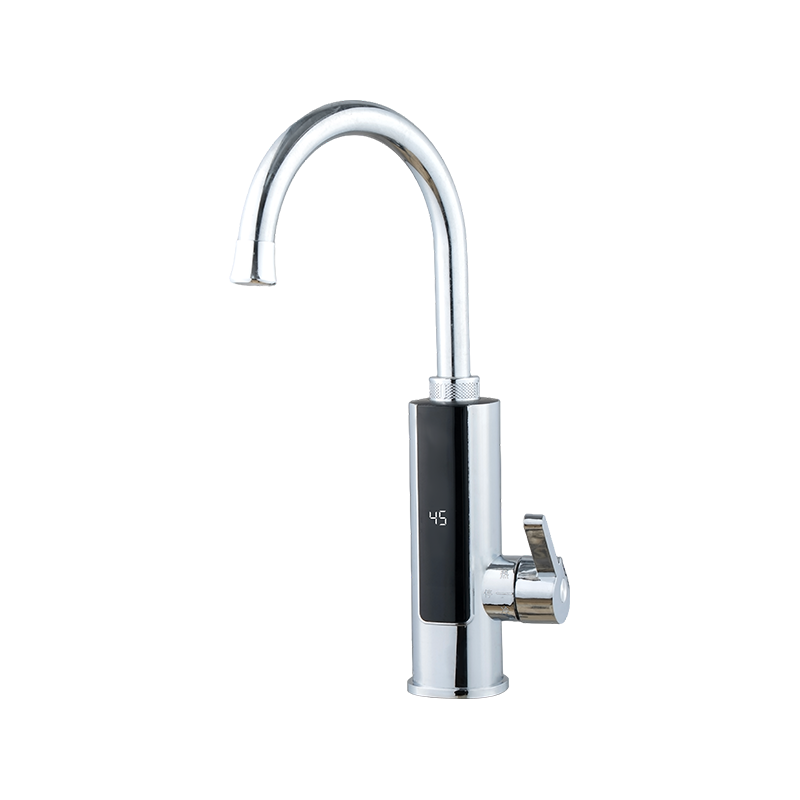
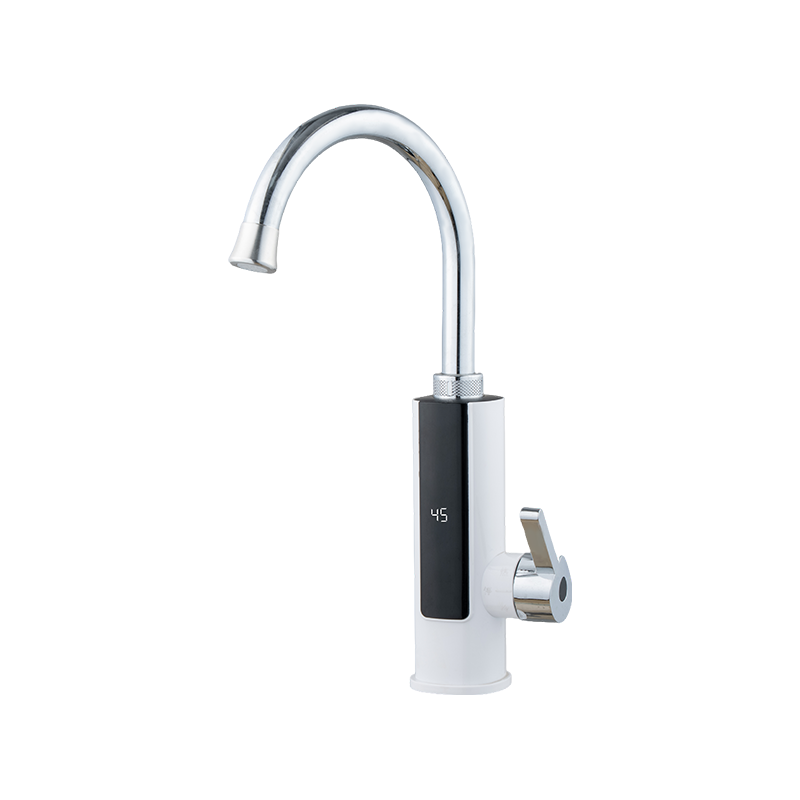
Within the ABS kitchen faucet category, most product lines are organized around the finish applied over the plastic housing and the control interface built into the spout base. Electroplated finishes give the ABS body a chrome or brushed silver appearance that closely resembles metal, while unplated matte finishes are used on more budget oriented lines. Control interfaces range from a simple manual knob to a full LED digital temperature display, and some models add a rotatable pipe or a dual outlet for added flexibility at the sink.
Electroplated ABS Kitchen Faucets
These units apply a thin metallic electroplating layer over the molded ABS body, giving the faucet a silver or chrome look while keeping the underlying material light and non-conductive. This finish is popular where buyers want a faucet that visually matches stainless steel fixtures elsewhere in the kitchen.
Digital Display ABS Faucets
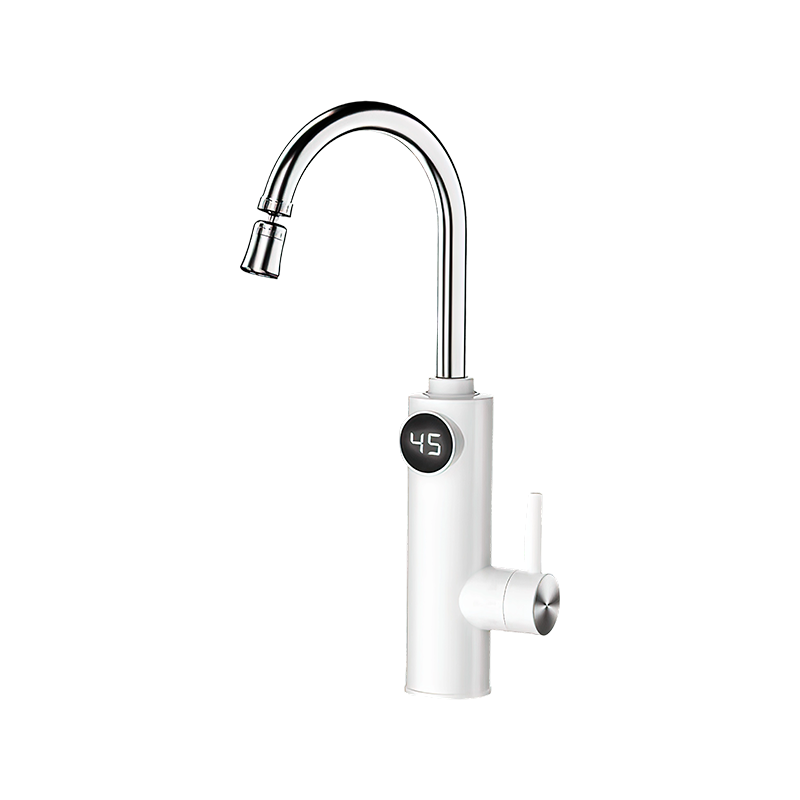
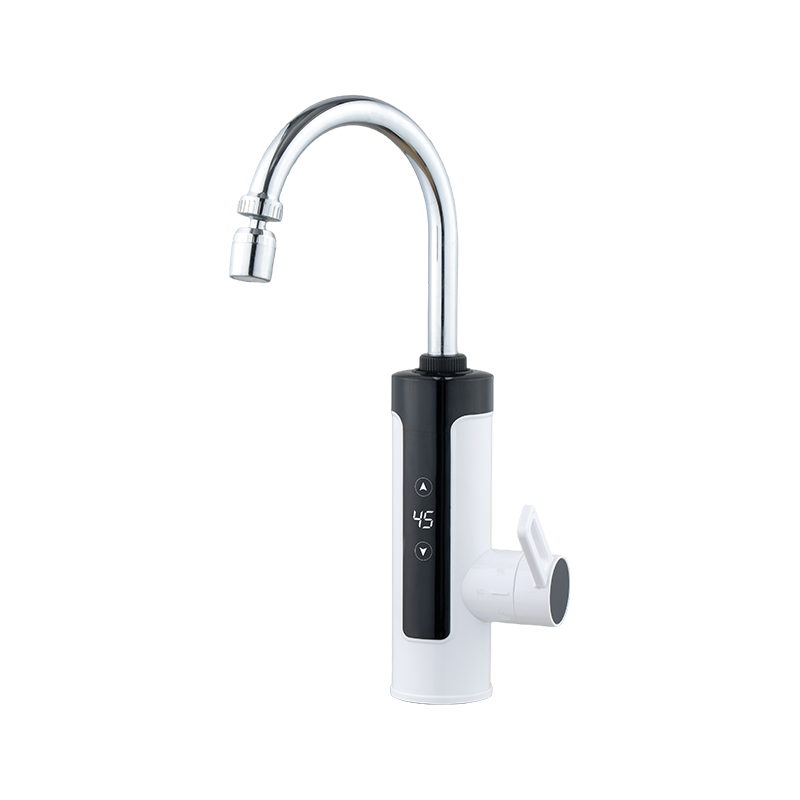
Digital display models add an LED or LCD panel that shows the current outlet temperature and power status, giving the user more precise control over the heated water than a simple knob allows.
Rotatable Pipe and Dual Outlet Configurations
A 360 degree rotatable pipe allows the spout to swing between a main sink bowl and a secondary basin, while a dual outlet design splits water flow between a fixed spout and a handheld hose for rinsing tasks.
Electroplate Silver Finish
Metallic-look coating over ABS for a stainless steel appearance at a lighter weight. LED Digital Display
Shows live outlet temperature so users can fine tune heating level at the tap. 360 Degree Rotatable Pipe
Swings between sink bowls, useful for double basin kitchen setups. Overheating Protection
Built in thermal cut-off that interrupts power if temperature exceeds a safe limit.
| Configuration | Control Type | Typical Finish | Common Power Range |
|---|---|---|---|
| Basic knob control | Manual knob | Matte or plain ABS | 3000W to 4500W |
| Digital display | LED or LCD panel | Electroplate silver | 3500W to 5500W |
| Rotatable pipe | Knob or digital | Electroplate silver | 3500W to 5000W |
| Dual outlet | Digital | Electroplate silver | 4000W to 5500W |
Key takeaway: ABS kitchen faucets range from basic knob controlled units to digital display and dual outlet configurations, all built on the same lightweight, non-conductive housing material.
Why Manufacturers Choose ABS: Structure and Material Principle
The internal heating principle of an ABS instant electric kitchen faucet is the same tankless, flow-activated design used across the wider instant electric faucet category: cold water passes across a heating element inside a sealed chamber and reaches the spout already warmed to the selected temperature. What differs with an ABS unit is the housing that surrounds this heating chamber and control electronics, and that housing material choice has direct safety and manufacturing implications.
- ABS is a naturally non-conductive polymer, which adds a layer of electrical insulation around the heating element and wiring inside the faucet body.
- The material can be injection molded into complex gooseneck and rotatable pipe shapes with consistent wall thickness, which is harder to achieve economically with sheet metal.
- ABS does not rust or corrode from water exposure the way untreated metal can, which supports long-term appearance in a wet kitchen environment.
- Its lighter weight compared with stainless steel reduces shipping cost per unit and makes wall mounting simpler for the installer.
- Electroplating can be applied over the molded ABS surface to achieve a metallic appearance without the cost of a solid metal body.
Internally, the heating element, thermal cut-off, flow sensor, and grounding terminal are arranged in the same functional sequence found in metal-bodied units, so the safety performance of the faucet depends more on the quality of these internal components and the grounding path than on the housing material itself. What the ABS housing changes is how heat and electrical current are contained around those components, and reputable manufacturers select ABS grades rated for the operating temperature range the faucet will reach in normal use, rather than a generic low cost resin.
Key takeaway: The heating principle inside an ABS faucet matches the wider instant electric faucet category, while the ABS housing itself adds electrical insulation, corrosion resistance, and lighter weight around that internal structure.
Material Comparison: ABS Housing vs Stainless Steel Housing
Buyers sourcing kitchen faucets often ask how an ABS housing compares with a stainless steel housing across the attributes that matter for a kitchen environment. Four attributes are commonly used for this kind of comparison: weight, corrosion resistance, electrical insulation, and cost efficiency. Weight affects shipping cost and how easy the unit is to mount, corrosion resistance affects long-term appearance under constant water exposure, electrical insulation is a safety-relevant property given the internal heating element, and cost efficiency affects how competitively the finished faucet can be priced. The column chart below scores both materials on a relative zero to ten scale across these four attributes, based on general material property characteristics rather than a test of one specific product pair.
Reading the chart from left to right, ABS scores noticeably higher on weight, reflecting how much lighter a molded plastic housing is compared with a solid metal body of similar dimensions. On corrosion resistance, stainless steel scores marginally higher, since metal alloys formulated for kitchen fixtures are also engineered to resist rust and pitting, though ABS still performs well in this category because plastic does not corrode in the traditional sense at all. Electrical insulation shows the widest gap in favor of ABS, which is consistent with plastic being a natural electrical insulator, while metal housings require additional internal insulating components to achieve a comparable safety margin around the heating element. Cost efficiency also favors ABS by a wide margin, largely because injection molding a plastic housing is generally less resource intensive than stamping, welding, and polishing a stainless steel equivalent at the same production volume. Taken together, the pattern in this chart explains why ABS has become the dominant housing choice for mid-volume, cost-conscious kitchen faucet lines, while stainless steel remains more common in premium positioned product lines where a metal look and slightly higher corrosion resistance are prioritized over weight and unit cost. Neither material is universally superior across every attribute, which is why many manufacturers, including those serving export markets, offer both ABS and stainless steel versions of the same faucet body shape side by side. For a wholesale buyer, the right choice generally comes down to the target retail price point and the finish expectations of the destination market rather than a single technical attribute. It is also worth noting that a well engineered ABS housing with a quality electroplated finish can visually resemble stainless steel closely enough that end users may not immediately distinguish the two materials at the point of sale. This is one reason electroplated ABS has grown as a category, since it captures much of the visual appeal typically associated with metal while retaining the weight, insulation, and cost advantages shown in this chart. Distributors evaluating a new supplier relationship should ask specifically which ABS grade and electroplating process is used, since quality varies meaningfully between manufacturers even within the same general material category.
Key takeaway: ABS outperforms stainless steel on weight, electrical insulation, and cost efficiency, while stainless steel holds a small edge on raw corrosion resistance.
Selecting the Right ABS Kitchen Faucet for Your Project
Choosing between the available ABS configurations starts with matching the control interface and spout style to how the kitchen sink is actually used, then confirming that the power rating and voltage fit the destination market's electrical standard. Buyers sourcing for budget housing projects, mid-range residential kitchens, or rental units will often prioritize different features even though the underlying ABS housing and heating principle stay the same across the range.
Application Scenarios
|
Selection Tips
|
For wholesale and OEM buyers, it also helps to ask the manufacturer whether the electroplated finish carries a separate durability rating, since plating quality varies more between suppliers than the base ABS resin does. A supplier able to support small customization requests, such as spout length or control panel branding, alongside a standard ABS electric kitchen faucet line is generally easier to work with across multiple export markets.
Key takeaway: Matching control interface, finish, and voltage to the target project, and confirming plating quality with the factory, helps avoid mismatched orders later.
Demand Trend for ABS Finish Kitchen Faucets
Interest in ABS finish kitchen faucets has generally trended upward over the past several years, tracking alongside broader growth in the wider instant electric faucet category. Budget-conscious renovation projects and rental property upgrades have been a consistent source of demand, since ABS units allow property owners to add hot water at a sink without the higher material cost of a stainless steel body. Export buyers in price-sensitive markets have also shown growing interest in ABS lines specifically because of the lower shipping weight discussed in the earlier material comparison. At the same time, improvements in electroplating quality have made ABS faucets more visually competitive with metal bodied units than in earlier product generations. The area chart below presents a relative demand index across recent years to illustrate this general upward direction.
The filled area under the curve rises steadily from left to right without any year showing a decline, which points to sustained rather than short-lived demand for ABS finish kitchen faucets. The pace of growth appears fairly even across the period shown, suggesting this is a gradual structural shift in buyer preference rather than a single-year spike tied to one unusual event. By 2025, the index sits well above its 2021 starting point, indicating that ABS has moved from a secondary option to a mainstream housing choice within the broader kitchen faucet category over this window. This kind of steady climb is generally a useful signal for distributors deciding how much shelf space or catalog emphasis to give ABS models relative to stainless steel alternatives. It also supports continued investment by manufacturers in electroplating quality, since a growing buyer base tends to reward finish improvements that narrow the visual gap with metal housings. For export-focused buyers, a rising domestic demand index in the country of manufacture often precedes similar interest in international markets, since design and finish improvements developed for local demand are typically extended to export product lines soon afterward. It is worth repeating that this index reflects relative direction and pace of change rather than an exact unit volume figure, since translating a demand index into absolute sales requires additional market-specific data beyond the scope of this general trend illustration. Even with that limitation, the consistent upward slope shown here is consistent with how ABS kitchen faucets are generally described in current sourcing and distribution conversations. Buyers evaluating whether to add or expand an ABS line in their own catalog can reasonably treat this kind of multi-year trend as one supporting data point, alongside direct customer feedback and local retail pricing research. The steady nature of the trend, rather than a sharp spike, also suggests that ABS demand is likely to remain a durable rather than temporary part of the category going forward.
Key takeaway: Demand for ABS finish kitchen faucets has grown steadily over recent years, reflecting a durable shift toward lightweight, cost efficient housing rather than a short-term trend.
Buyer Preference for ABS in Budget-Focused Kitchen Projects
Among buyers specifically sourcing for budget-focused kitchen retrofit projects, ABS tends to be the preferred housing material more often than not, largely because of the cost efficiency and lightweight advantages covered in the material comparison section above. This preference is strongest in projects where the faucet is one of many fixtures being sourced at once, such as multi-unit rental buildings or dormitory renovations, where cumulative weight and unit cost across dozens or hundreds of faucets add up quickly. Property managers overseeing these projects also value that a lighter ABS unit is easier for onsite maintenance staff to install and replace without specialized lifting or handling. The gauge chart below illustrates an approximate share of budget-focused kitchen retrofit buyers who indicate a preference for ABS housing over stainless steel when the two are offered at a similar price point. As with the earlier charts, this figure is a representative illustration of a commonly reported preference pattern rather than a precise survey result.
The gauge shows the majority of the ring filled, reflecting that a clear majority of budget-focused buyers lean toward ABS rather than stainless steel once price parity is assumed. This pattern lines up directly with the material comparison chart earlier in this article, where ABS scored higher on both weight and cost efficiency, two attributes that matter most in large-volume, budget-sensitive sourcing decisions. The remaining share of buyers who prefer stainless steel in this scenario likely place more weight on the marginal corrosion resistance advantage or on a specific metallic look requested by an end client, both of which were also reflected in the earlier comparison. It is useful for distributors to read this kind of preference figure alongside the project type, since the same buyer might choose differently for a premium residential project than for a budget rental retrofit. A gauge like this is most valuable as a quick reference point during sourcing conversations, helping a distributor set expectations before a buyer even asks which material to stock in higher volume. For manufacturers, a preference figure skewed this strongly toward ABS supports continued investment in improving electroplating durability, since that is the main lever available to narrow the remaining gap with stainless steel on perceived quality. It also suggests that offering an ABS option alongside any stainless steel line is likely to capture a meaningful share of budget-focused demand that would otherwise be lost to a metal-only catalog. As with the earlier demand trend chart, this preference figure should be treated as a directional, illustrative reference rather than a precise market research statistic, since actual preference will vary by region, project type, and the specific finish options on offer. Even with that caveat in mind, the general pattern shown here, a clear majority preference for ABS in budget-focused kitchen projects, is consistent with how this category is typically described by distributors working across both stainless steel and ABS product lines.
Key takeaway: A clear majority of budget-focused kitchen retrofit buyers indicate a preference for ABS housing over stainless steel when the two are priced comparably.
Feature Configuration Mix Across ABS Kitchen Faucet Model Lines
Beyond the housing material itself, ABS kitchen faucet catalogs have also shifted in terms of which control features are most common across a typical model lineup. Earlier generations of ABS kitchen faucets leaned heavily on simple knob control as the default configuration, largely because digital components added cost and complexity that many budget-focused buyers were not yet asking for. As digital displays, rotatable pipes, and dual outlet designs have become more affordable to manufacture, current model lineups have shifted noticeably toward these more feature-rich configurations. The stacked bar chart below compares the approximate feature mix of a current ABS kitchen faucet model lineup against a prior generation lineup, with each bar representing the full range of models offered.
In the current model lineup shown on the left, digital display models make up the largest single segment, followed by rotatable pipe, dual outlet, and basic knob configurations in decreasing order, indicating that feature-rich models now dominate a typical modern ABS kitchen faucet catalog. The prior generation lineup on the right shows a very different pattern, with basic knob control forming the largest segment by a wide margin and digital display representing a much smaller share of the total lineup. This shift reflects the broader trend covered in the demand section above, where growing interest in ABS kitchen faucets has coincided with buyers expecting more precise, digital control rather than settling for a simple manual knob. The relative shrinkage of the basic knob segment does not mean this configuration has disappeared entirely, since it remains a relevant option for the most price-sensitive budget projects described earlier in this article. Instead, the chart shows a rebalancing of catalog emphasis, with manufacturers now offering digital and rotatable pipe options as the default expectation rather than an upgrade tier. For distributors, this shift suggests that stocking a current-generation lineup weighted toward digital display and rotatable pipe models is more likely to match present-day buyer expectations than replicating an older, knob-heavy catalog structure. It also means that a small remaining allocation to basic knob models still makes sense for serving the most cost-constrained segment of the market rather than being phased out completely. Manufacturers considering how to allocate limited production capacity across configurations can use this kind of comparison to justify shifting more capacity toward digital and rotatable pipe models while maintaining a smaller basic knob line. As with the other charts in this article, the specific percentages shown here are illustrative of a general industry pattern rather than an exact figure tied to one manufacturer's actual production data. The overall direction, however, a clear shift away from basic knob control and toward digital and rotatable pipe configurations, is consistent with how the ABS kitchen faucet category has generally evolved over recent product generations.
Key takeaway: Current ABS kitchen faucet lineups are weighted more heavily toward digital display and rotatable pipe configurations, a clear shift away from the basic knob control that dominated prior generation catalogs.
Installation Guidelines and Safety Considerations
Installing an ABS instant electric kitchen faucet follows the same general sequence as other instant electric faucets, though the lighter housing makes handling and mounting somewhat easier for a single installer. Many manufacturers recommend that the electrical connection be completed by someone familiar with local wiring practices, even though the tankless design keeps the overall job short.
- Shut off the water supply at the nearest valve before removing the existing kitchen faucet.
- Clean the sink deck or mounting hole and check that the new ABS faucet base fits without excess force.
- Mount the faucet body and secure the base nut, taking care not to overtighten against the lighter ABS material.
- Connect the water supply line and confirm all fittings are properly seated before restoring pressure.
- Complete the electrical connection, confirming a proper grounding point and leakage protection where required.
- Turn the water back on and run the tap briefly to confirm heating activation and check for leaks.
Because ABS is lighter than metal, installers should avoid overtightening the mounting nut, since excessive torque on plastic threads can cause cracking that would not occur with a metal housing. Buyers should also confirm that the faucet includes overheating protection and a proper grounding terminal, both of which were covered in the structure and material principle section earlier in this article. As with any electric faucet, avoiding an extension cord for the power connection and keeping the circuit free of other high-draw appliances supports safe, reliable operation.
Key takeaway: ABS faucets install with the same basic sequence as other instant electric faucets, with the main extra precaution being to avoid overtightening the lighter plastic mounting nut.
Maintenance Guidance for ABS Kitchen Faucets
Maintaining an ABS kitchen faucet is generally straightforward, though a few habits specific to the plastic housing and electroplated finish help preserve appearance and performance over time.
- Clean the electroplated surface with a soft cloth and mild soap rather than abrasive scouring pads that can scratch the plating.
- Avoid harsh solvent-based cleaners, which can dull or discolor the ABS surface over repeated use.
- Clean or replace the inlet filter screen periodically to prevent sediment from restricting flow into the heating chamber.
- Inspect the power cord and plug regularly, replacing immediately if any wear or damage is visible.
- Test the overheating protection and leakage protection functions on a routine schedule if the model includes a test button.
Because the housing does not rust, most long-term maintenance concerns relate to the finish and the internal heating components rather than the base material itself. For rental properties and multi-unit projects, keeping spare filter screens and seals on hand allows maintenance staff to complete a fast turnaround without waiting on a full replacement unit.
Key takeaway: Gentle cleaning of the plated finish, routine filter checks, and periodic safety function testing are usually sufficient to keep an ABS kitchen faucet performing reliably.
Choosing a Reliable ABS Kitchen Faucet Manufacturer
For wholesale and OEM buyers, the choice of ABS electric kitchen faucet manufacturer matters just as much as the faucet specification itself, since ABS grade, electroplating process, and internal component quality all vary between factories even when the finished product looks similar on a spec sheet. Buyers generally look for a manufacturer with sufficient production scale to support recurring orders, a track record supplying established retail or brand partners, in-house after-sales support, and the flexibility to handle both branded and private-label requests.
Ningbo Maiteng Electric Appliance Co., Ltd. has focused on electric water heating faucets, including ABS kitchen faucet lines, since it was established in 2011, running an ISO9001 and CE certified facility of about 10,000 square meters with around 200 staff and an annual output near 2 million units. Production, sales, e-commerce, after-sales support, warehousing, and quality inspection are all handled internally, which supports both OEM manufacturing for outside brands and the company's own labeled products. The factory has supplied several well known domestic appliance brands over the years, while also building its own lines, Dongri Le and Aituosheng, alongside the HELLO DREAM brand launched in 2019. Sales run through a combination of direct operation and distribution across multiple Tmall, Pinduoduo, and Taobao enterprise stores plus an Alibaba wholesale platform store, giving the business steady exposure across different buyer segments. A dedicated foreign trade department was set up in 2023 specifically to support international ABS electric kitchen faucet supplier relationships and wholesale ABS kitchen faucet orders, extending the same production and quality control used for the domestic market to export buyers. For distributors evaluating a sourcing partner for OEM ABS electric kitchen faucet lines, this kind of established manufacturing base and dedicated export support are practical starting points for supplier due diligence.
Key takeaway: Confirming ABS grade, electroplating quality, production scale, and export support are the most useful checks when selecting an ABS kitchen faucet manufacturer.
Frequently Asked Questions
Q1: Is ABS plastic safe to use around an electric heating element in a faucet?Yes. ABS is a naturally non-conductive polymer, which adds electrical insulation around the internal heating chamber, and reputable manufacturers select ABS grades rated for the temperatures the faucet reaches in normal use. |
Q2: Does an ABS kitchen faucet look different from a stainless steel one?An electroplated ABS faucet closely resembles stainless steel in appearance, since the electroplating layer applied over the molded body gives it a similar silver or chrome look while keeping the housing lighter. |
Q3: What voltage options are available for ABS instant electric kitchen faucets?ABS kitchen faucets are commonly produced in both 110V and 220V configurations to match different regional electrical standards, so buyers should confirm the correct voltage for their destination market before ordering. |
Q4: Is ABS durable enough for daily kitchen use?Under normal kitchen conditions, ABS holds up well against water exposure and does not rust, though the mounting nut should not be overtightened and abrasive cleaning tools should be avoided to protect the plated finish. |
Q5: What safety features should buyers look for in an ABS kitchen faucet?Key features include overheating protection, a thermal cut-off, a proper grounding terminal, and, where available, an integrated leakage protection module that cuts power automatically if a current leak is detected. |
Q6: Can manufacturers supply ABS kitchen faucets as OEM or private label products?Many established manufacturers, including those with dedicated foreign trade departments, support both OEM production and private label branding for ABS kitchen faucet lines alongside their own branded products. |



NINGBO MAITENG ELECTRIC APPLIANCE CO., LTD. integrates production and sales. The company adopts a dual model of self-management and distribution sales.
- CONTACT INFO
-
NO.8 Yaobei Avenue,Simen Town, Yuyao City, Ningbo City, Zhejiang, China
-
 +86-159 5821 2132
-
 +86-574-62178444
-
 +86-159 5821 2132
-
 [email protected]
[email protected]
-
- SCAN IT
-
Mobile terminal

