


 English
  Español
How Does a Tankless Water Heater Work?
Date:2025-11-28
Content
As consumers increasingly demand efficiency and energy conservation in their homes, traditional storage water heaters are gradually being replaced by a new type of product—the Tankless Water Heater (also known as an instant water heater). It eliminates the bulky storage tank, achieving the ideal "instant hot water" experience.
I. What is a Tankless Water Heater?
A tankless water heater is a hot water supply system that heats water on demand. Unlike traditional storage water heaters that require preheating and storing large amounts of hot water, it only starts the heating process when the user turns on the hot water tap. This design not only saves valuable space but also fundamentally eliminates standby energy consumption and the worry of running out of hot water.
II. Detailed Explanation of the Working Principle of a Tankless Water Heater
The key to the efficient operation of a tankless water heater lies in its precise linkage system, mainly composed of the following core components working together to complete the heating:
1. Start-up Signal: Flow Sensor
When you turn on the hot water tap, water begins to flow into the tankless water heater. The first thing to encounter the water flow is the flow sensor.
Operating Mechanism:
- Heating Principle: A flow sensor monitors the water flow rate and volume in real time. Once the water flow reaches the preset minimum start-up flow (usually very low), it immediately sends a "start heating" signal to the control system. This is the starting point of the entire instant heating process.
2. Core Heating: High-Efficiency Heat Exchanger
Upon receiving the start signal, the control system activates the gas burner or electric heating element, and water is pumped into the heat exchanger.
Gas-fired Principle: In a gas-fired tankless water heater, the burner ignites the gas, producing a high-temperature flame. Water flows rapidly through the coils inside the heat exchanger, and the heat generated by the high-temperature flame is efficiently transferred to the flowing cold water through the metal pipe walls.
Electric Principle: In an electric tankless water heater, water flows through a high-power electric heating element, which heats up rapidly, directly heating the water.
Key Characteristics: Due to the relatively fast water flow, the heat exchanger must possess extremely high thermal efficiency and a large contact surface area to ensure that the cold water is heated to the required temperature in a very short time.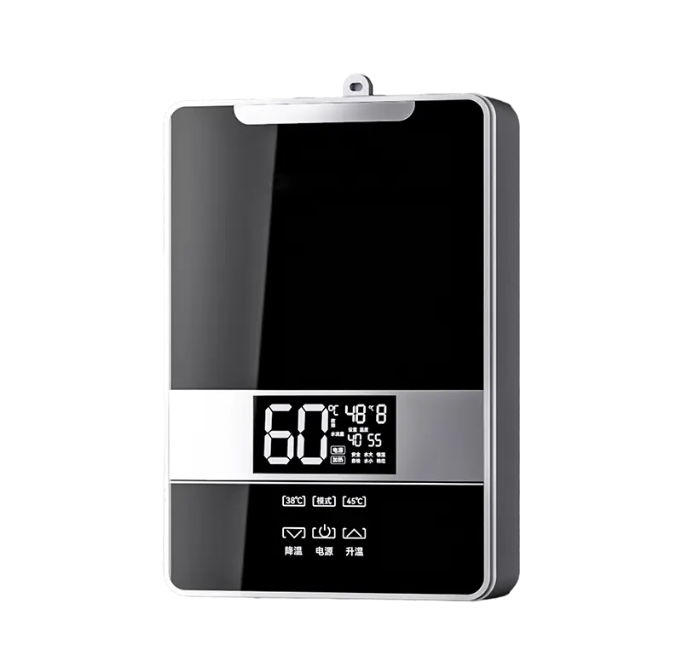
3. Precise Temperature Control: Thermostatic Control System
To ensure users receive a stable water temperature, tankless water heaters are equipped with an advanced thermostatic control system.
- Real-time Monitoring: Internal temperature sensors continuously monitor the outlet and inlet water temperatures.
- Intelligent Adjustment: The control chip accurately calculates and adjusts the gas/air mixing ratio of the burner (gas-type) or the power of the heating element (electric-type) based on three variables: the user-set temperature, the inlet water temperature, and the water flow rate.
- Effect: Regardless of fluctuations in water pressure or inlet water temperature, the system reacts quickly, ensuring the outlet water temperature remains at the user-set value, achieving true thermostatic control.
III. Main Advantages of Tankless Water Heaters
The popularity of Tankless Water Heater (instantaneous water heater) systems stems from the significant advantages brought by their unique working principle:
- Unlimited Hot Water Supply: As long as there is a continuous supply of cold water, it can continuously provide hot water—eliminating the embarrassment of “running out of hot water halfway through a shower.”
- High Energy Efficiency: Heating only when needed eliminates the standby loss of traditional water heaters, making energy efficiency significantly higher.
- Compact and Space-Saving: No storage tank is required, offering flexible installation and ideal suitability for small apartments.
- Constant Temperature and Comfort: Advanced thermostatic control technology ensures stable water temperature during use, enhancing comfort.
Tankless water heaters initiate heating via a flow sensor, instantly raise the water temperature using a high-efficiency heat exchanger, and ensure temperature stability through a precise thermostatic control system. This “heat-on-demand” working principle is the key to instant heating, energy saving, and comfortable temperature control.



NINGBO MAITENG ELECTRIC APPLIANCE CO., LTD. integrates production and sales. The company adopts a dual model of self-management and distribution sales.
- CONTACT INFO
-
NO.8 Yaobei Avenue,Simen Town, Yuyao City, Ningbo City, Zhejiang, China
-
 +86-159 5821 2132
-
 +86-574-62178444
-
 +86-159 5821 2132
-
 [email protected]
[email protected]
-
- SCAN IT
-
Mobile terminal

